ORMAN

Offline source reader | preserved content, not new verification

Vital community documentation.pdf

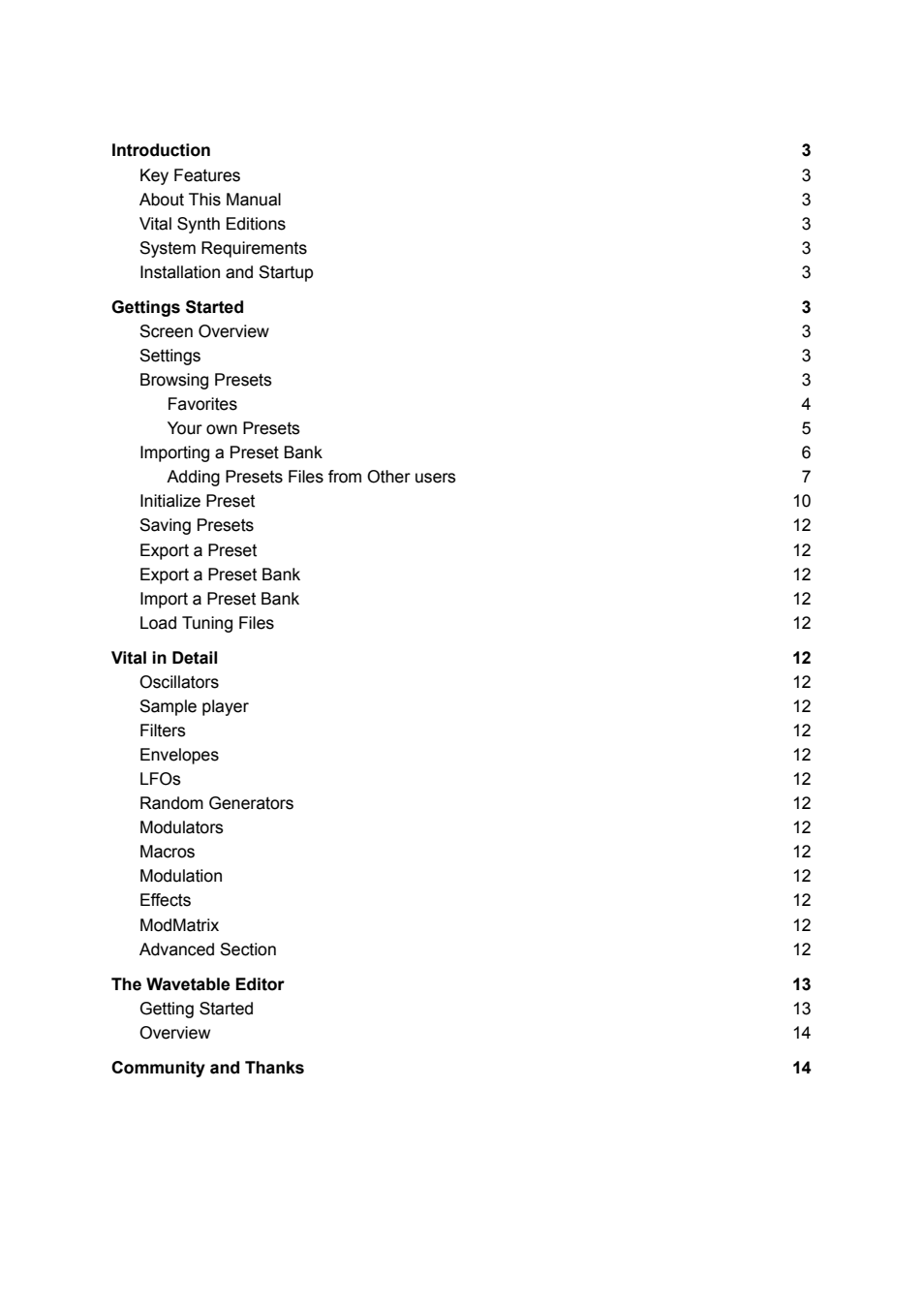
Preserved third-party source, not an ORMAN project instruction. Complete extracted article text is followed by every retained figure and its separately labeled project observation. Original files remain unchanged. For PDFs, use the original page images when extracted glyphs are unclear. Linked external audio/video and external repository trees were not part of the retained snapshot.

Unchanged original document | Complete extracted text

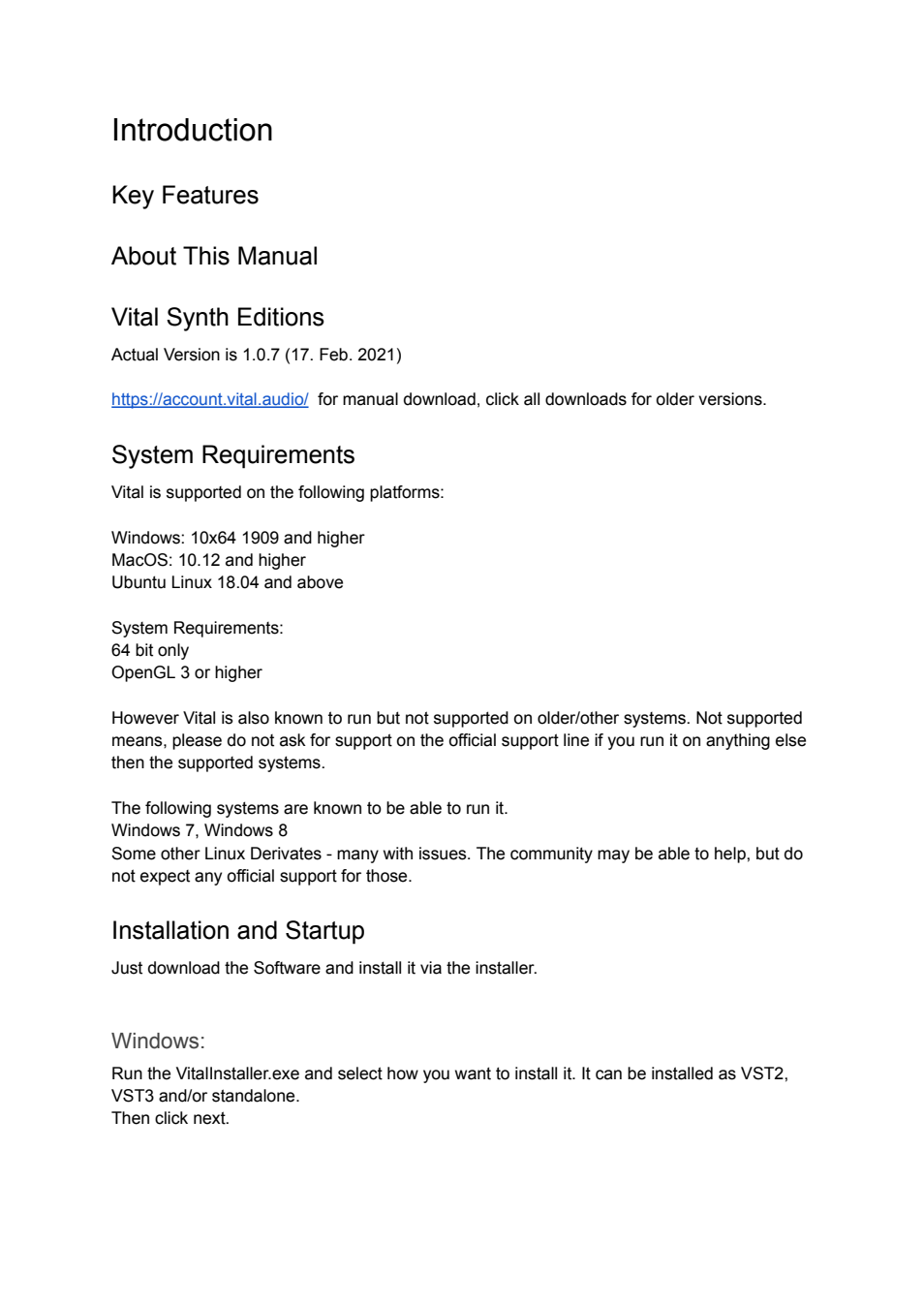
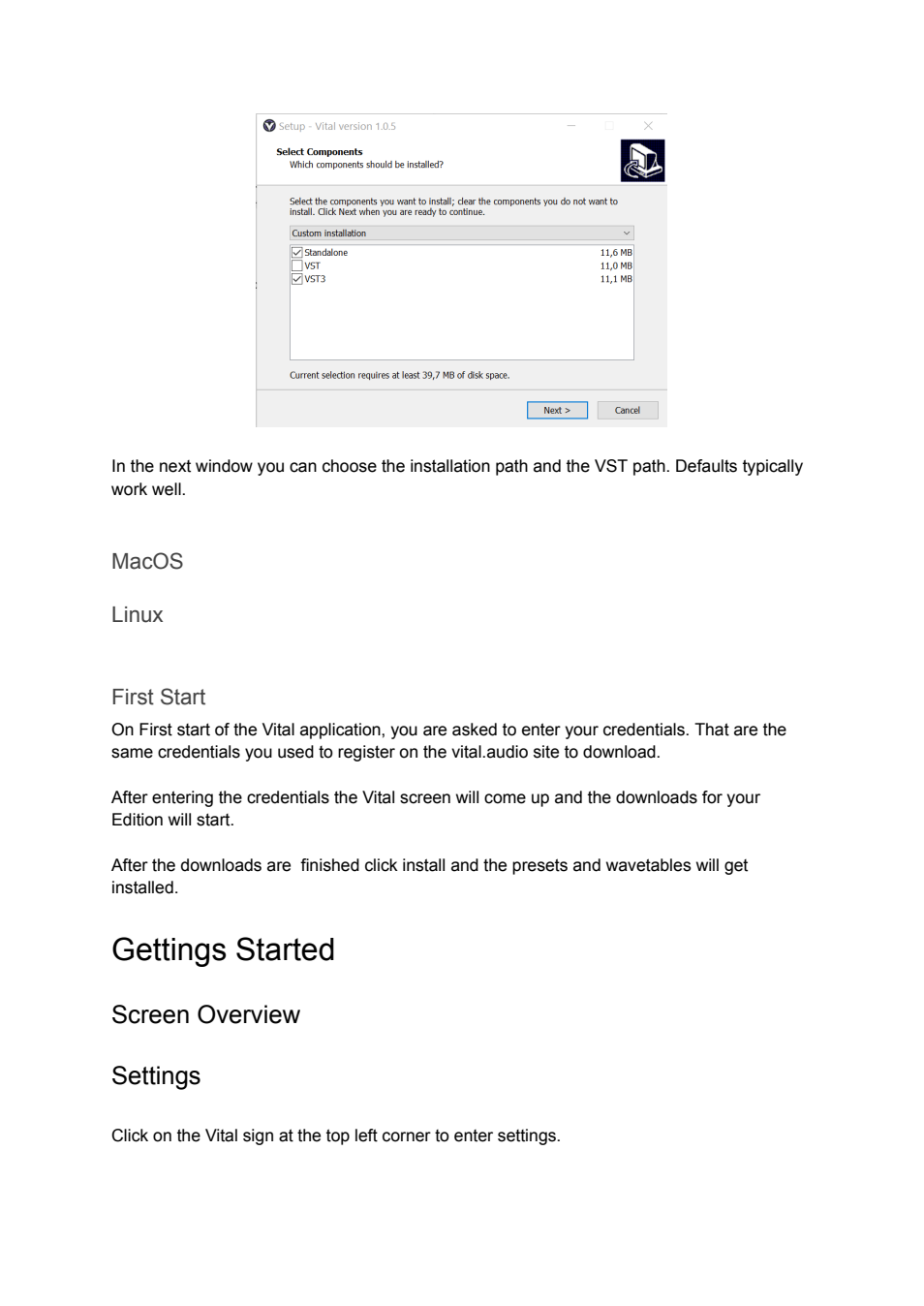
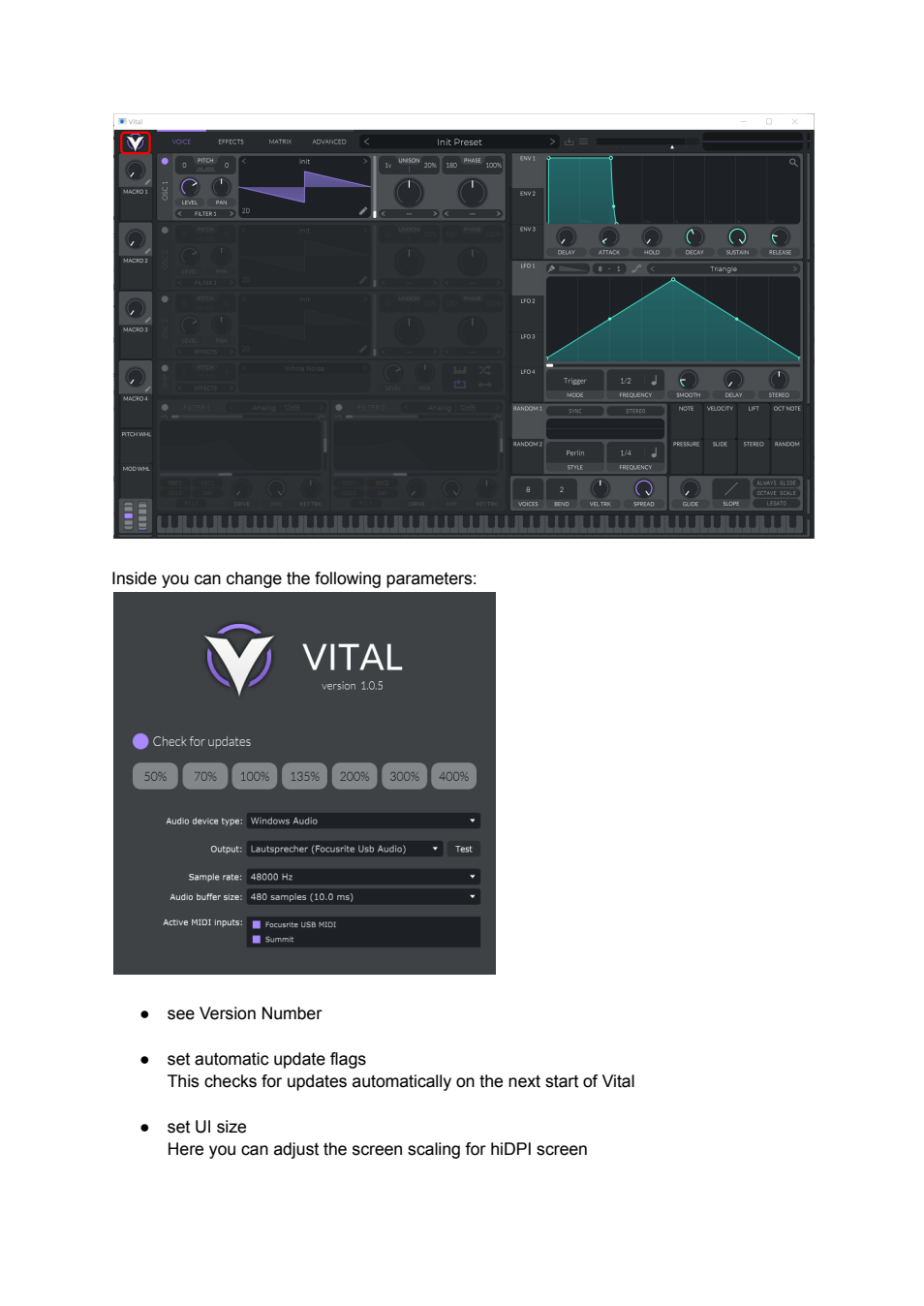
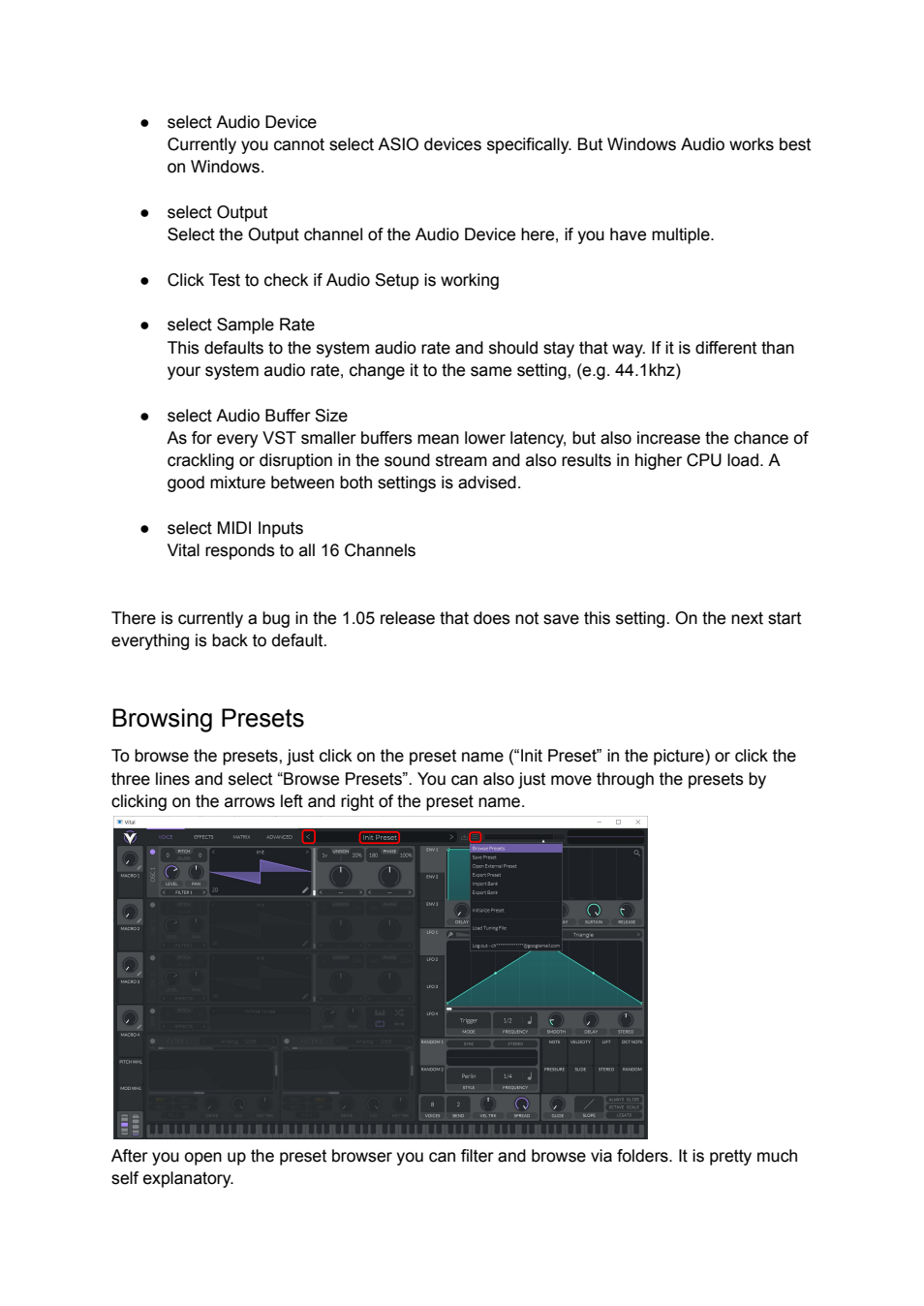
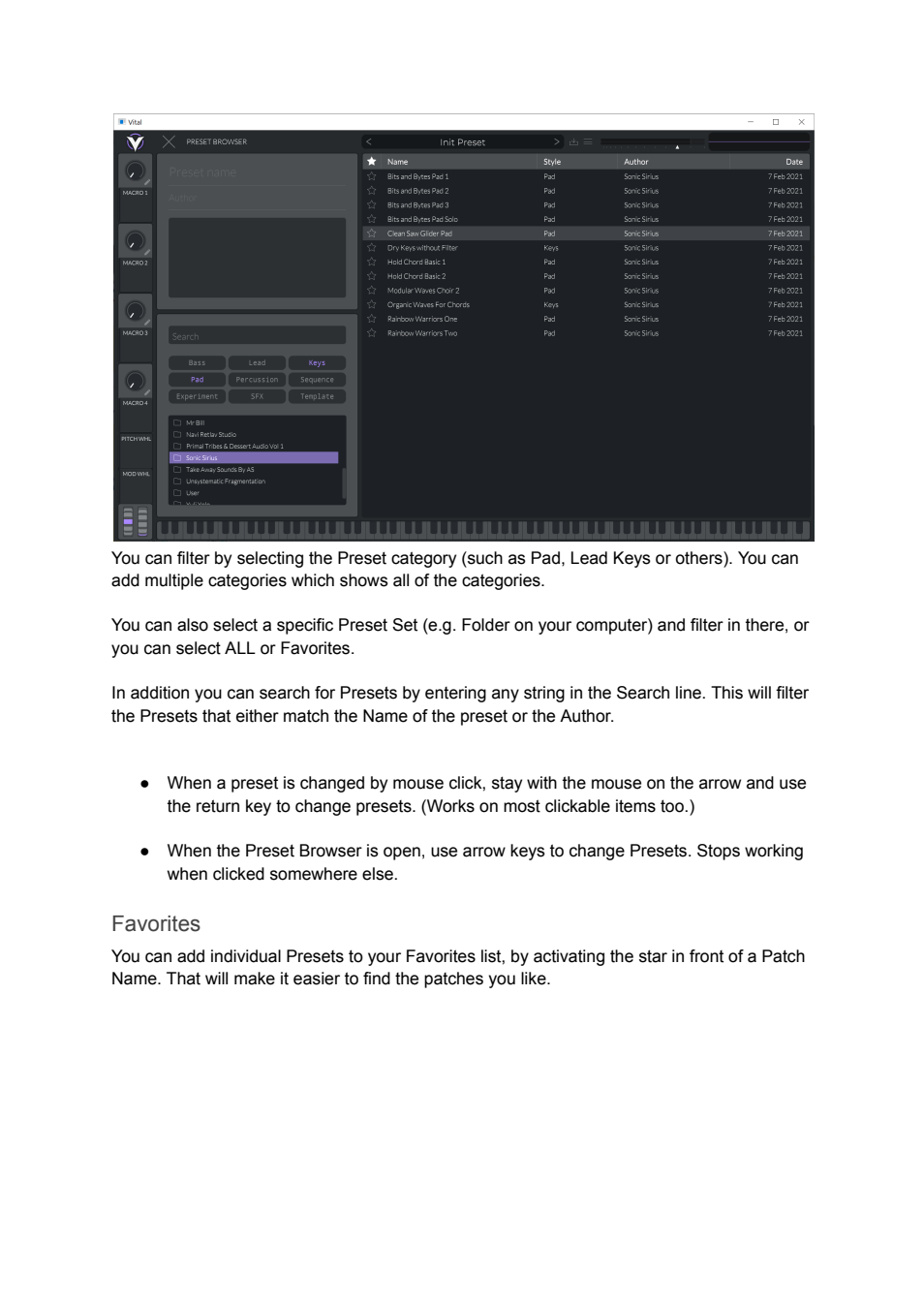
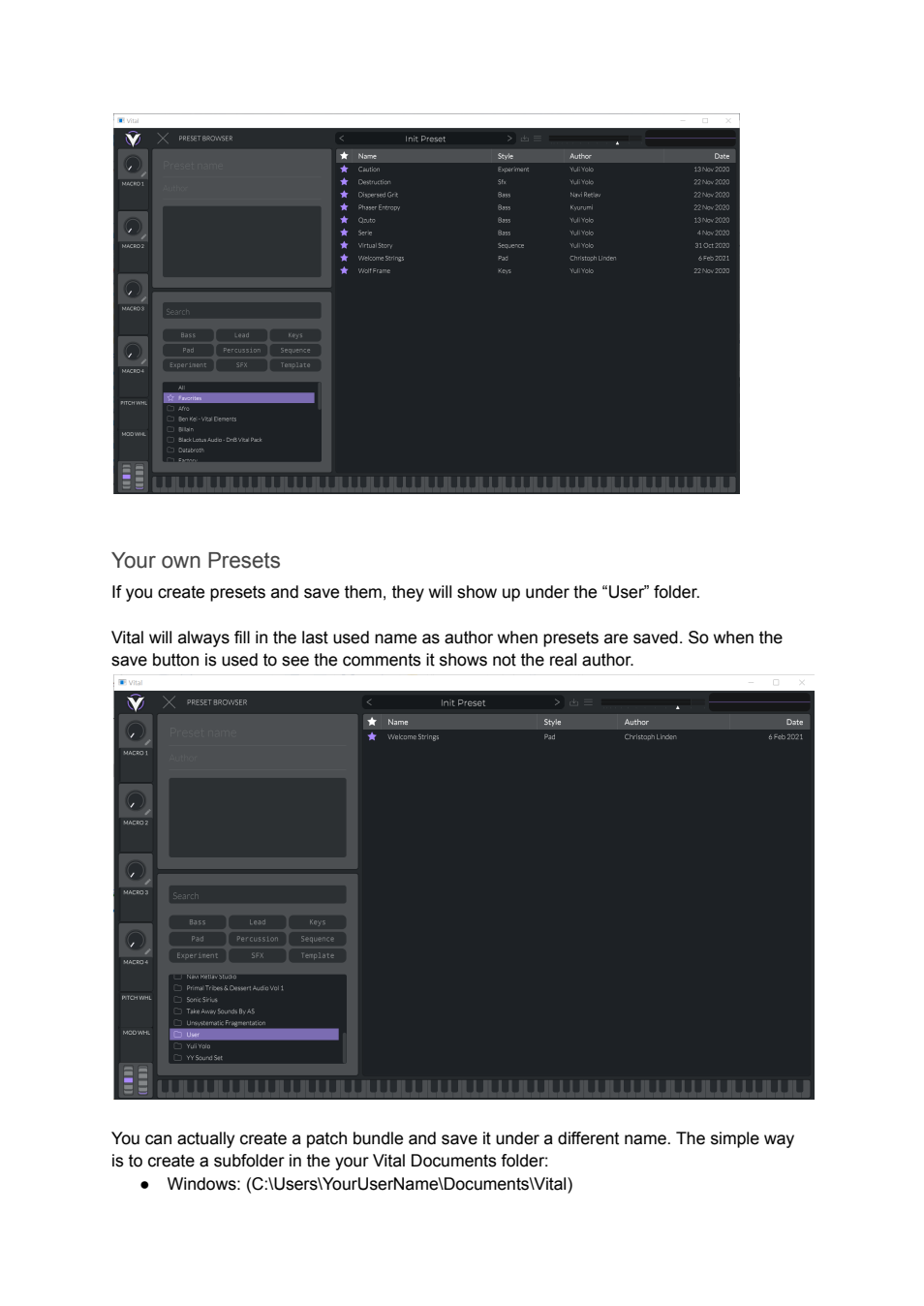
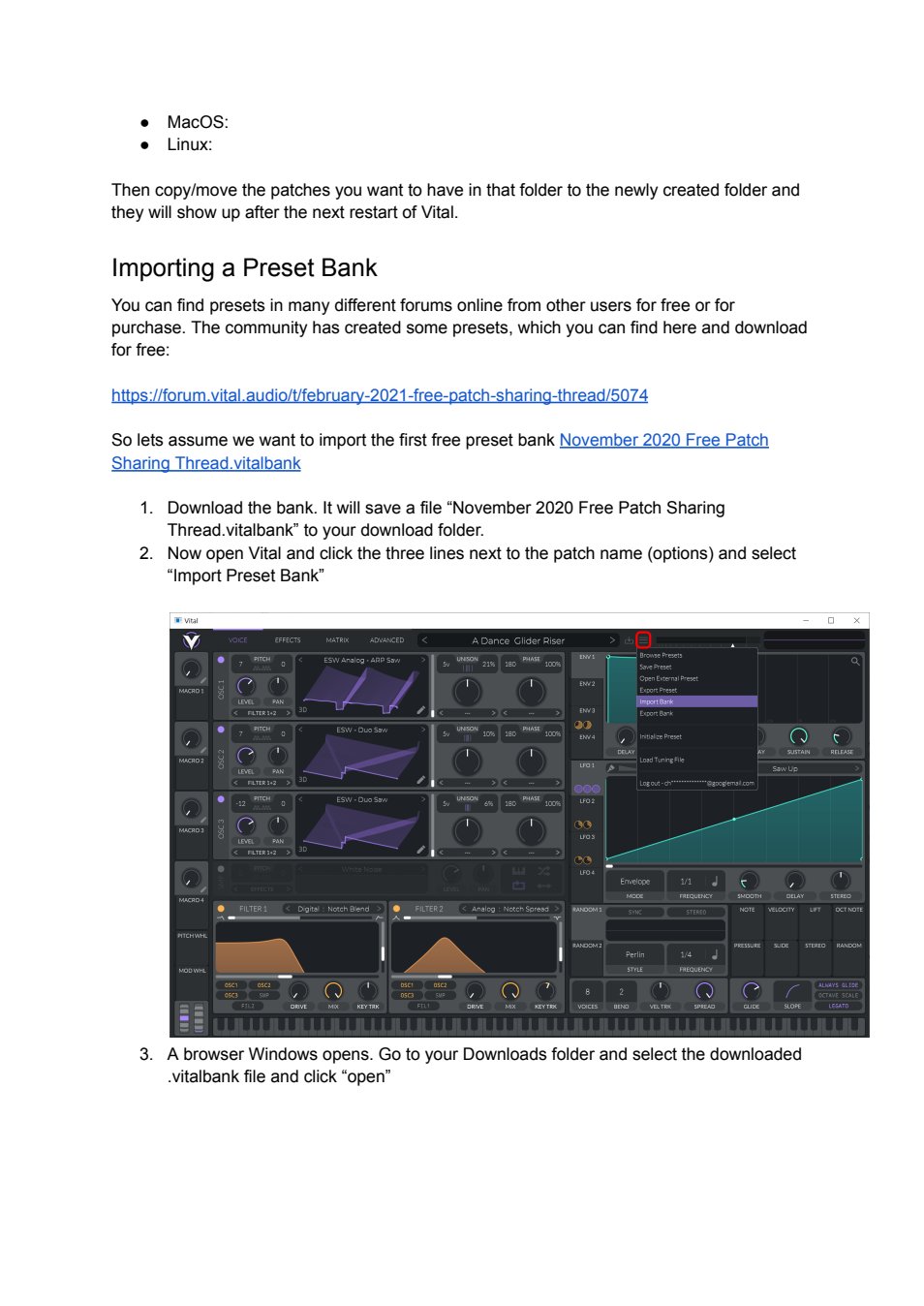
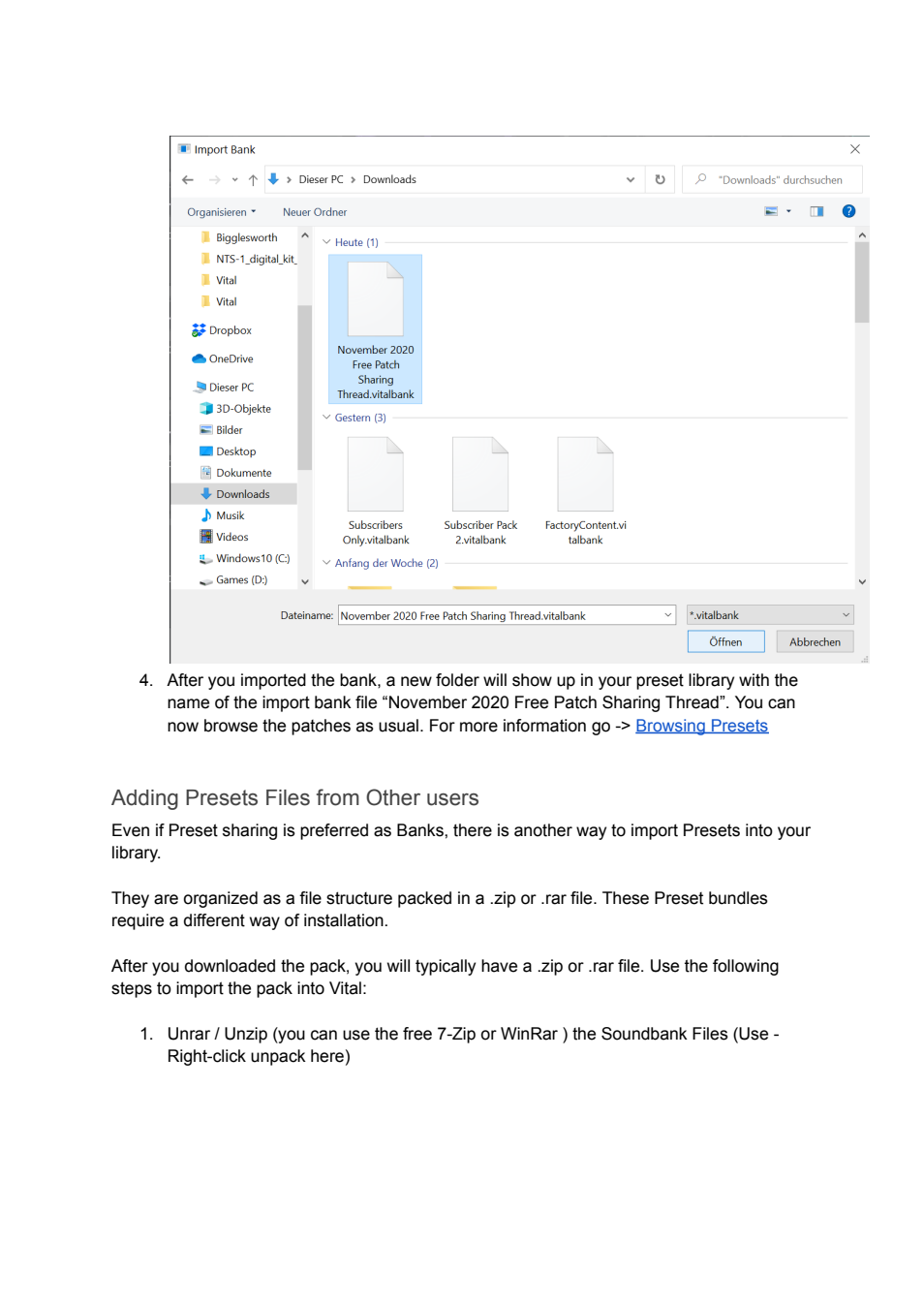
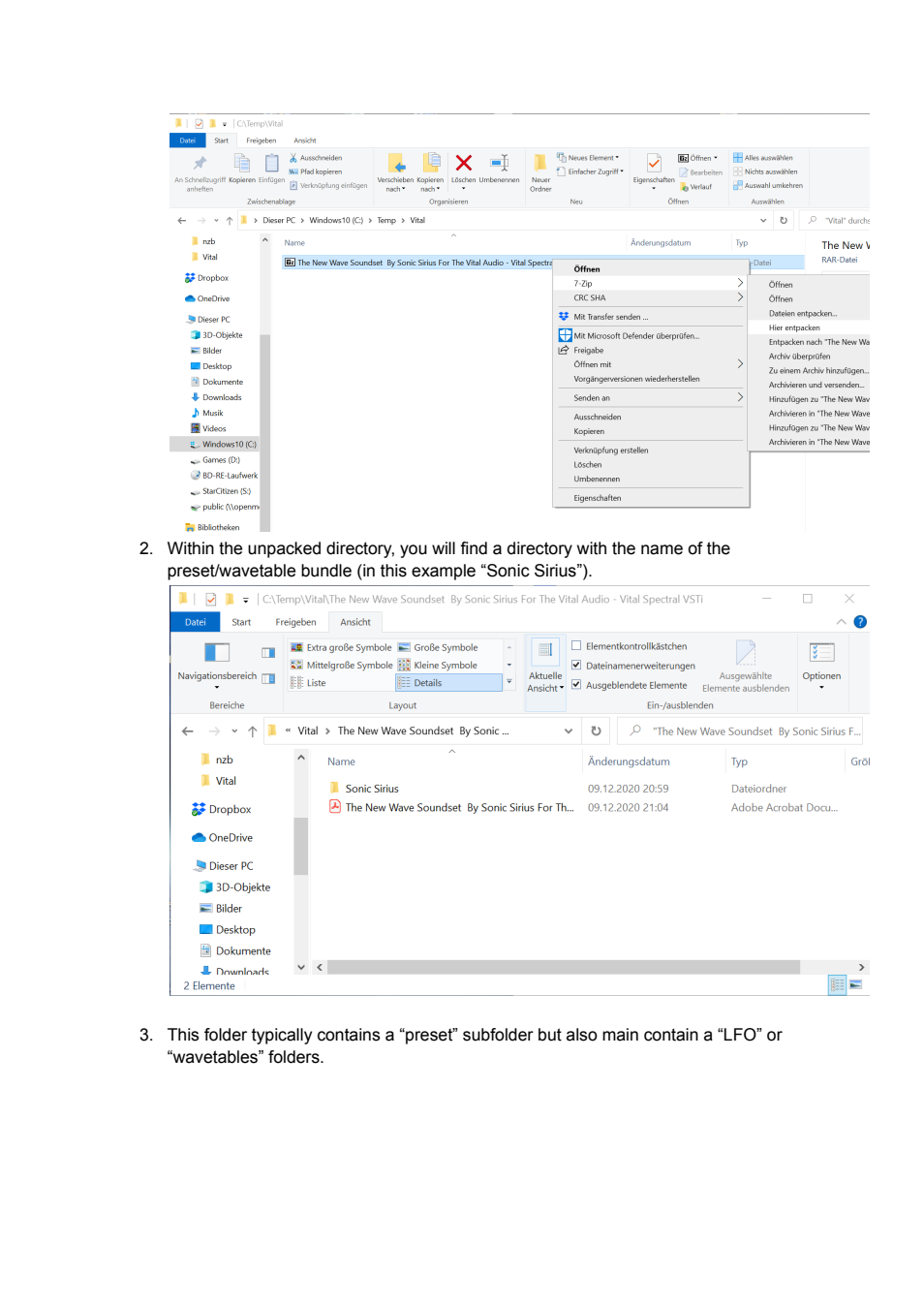
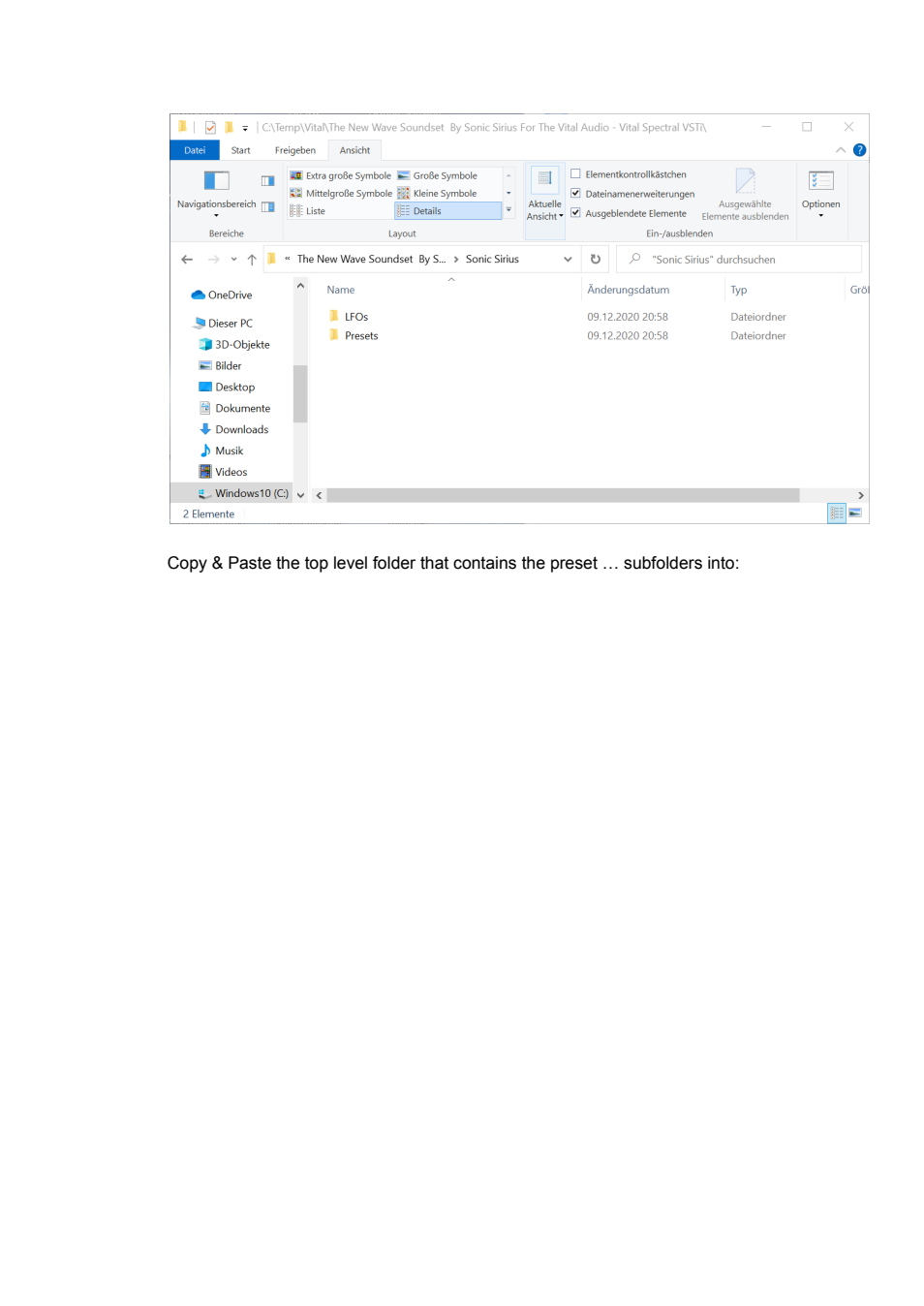
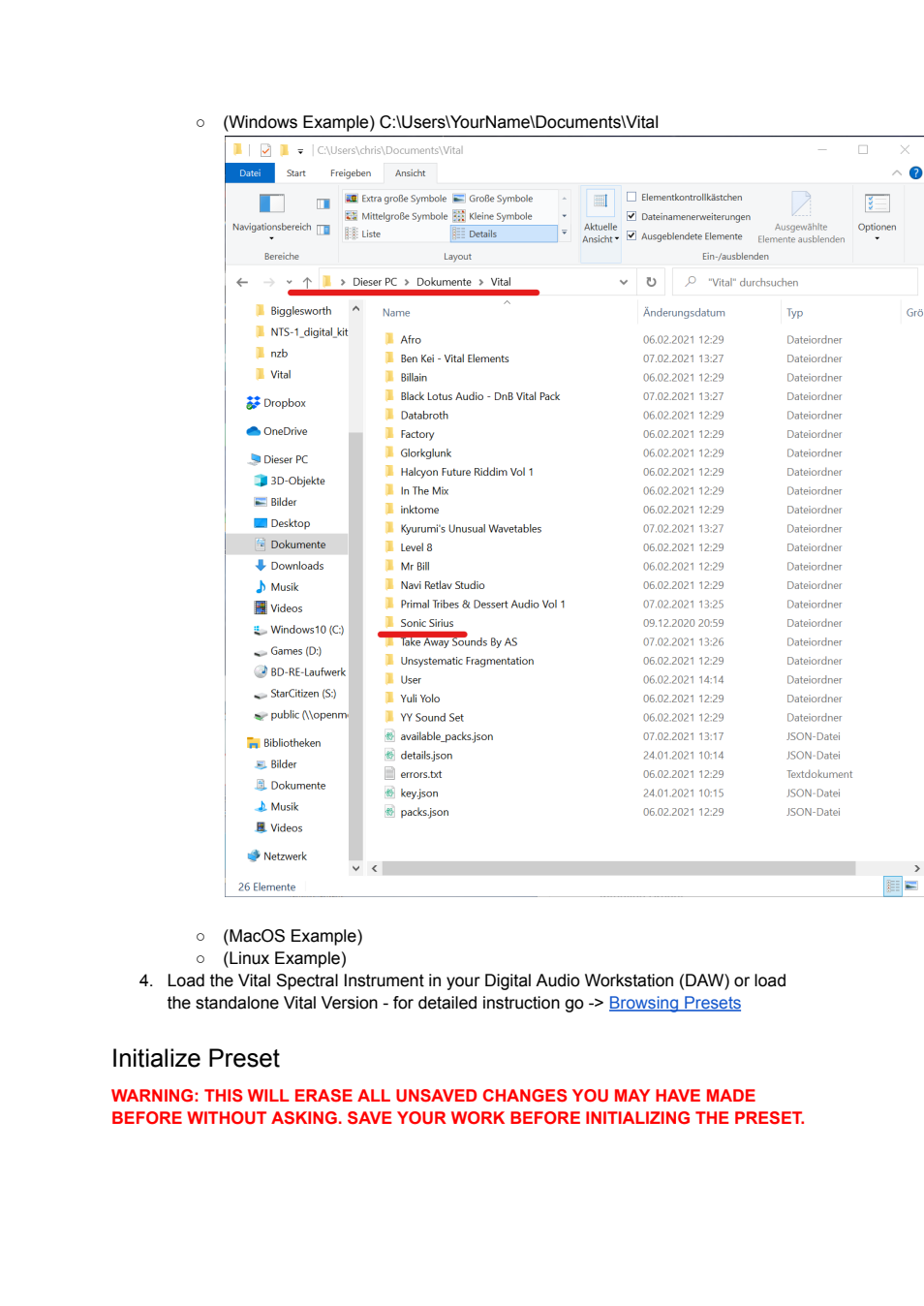
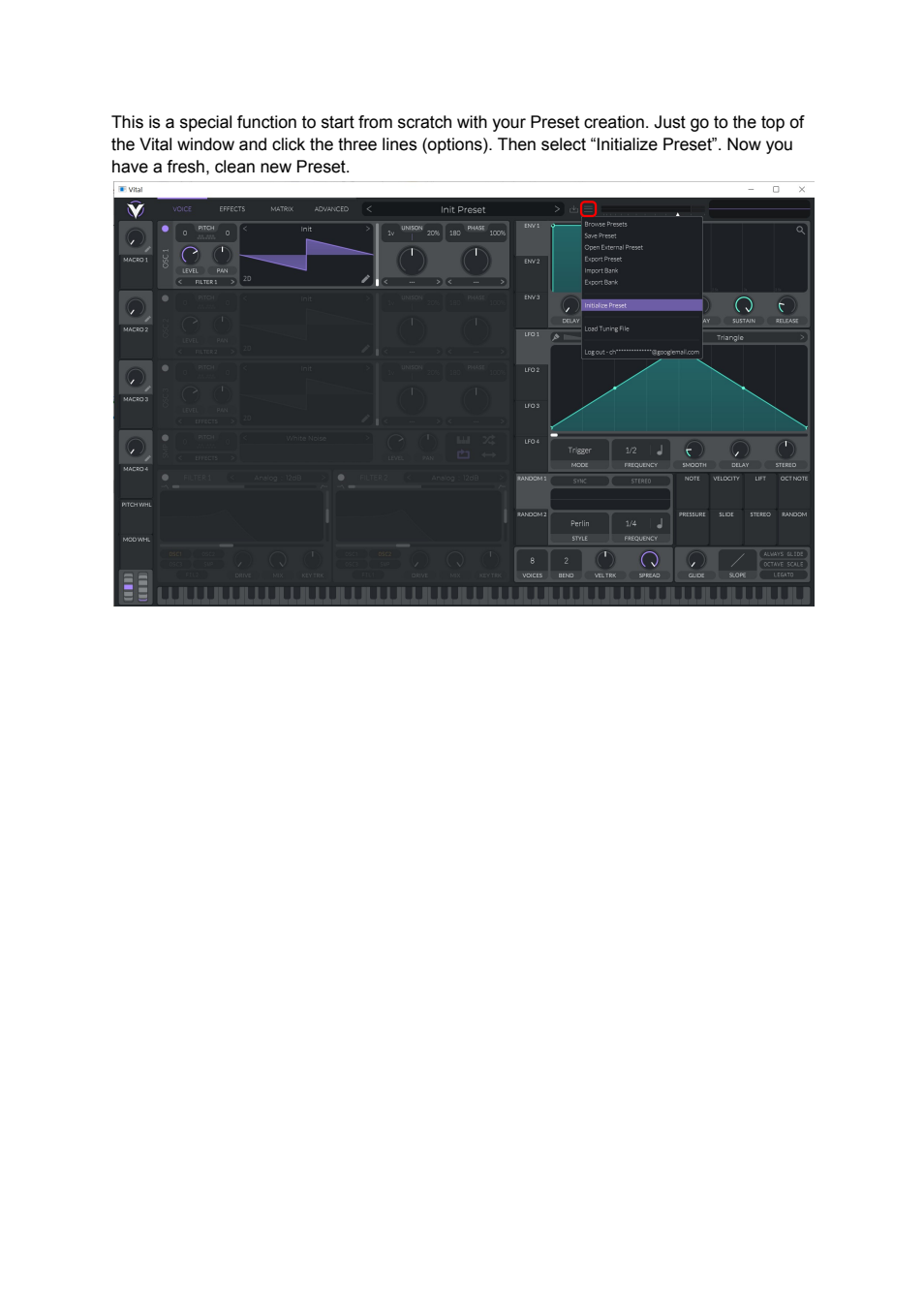
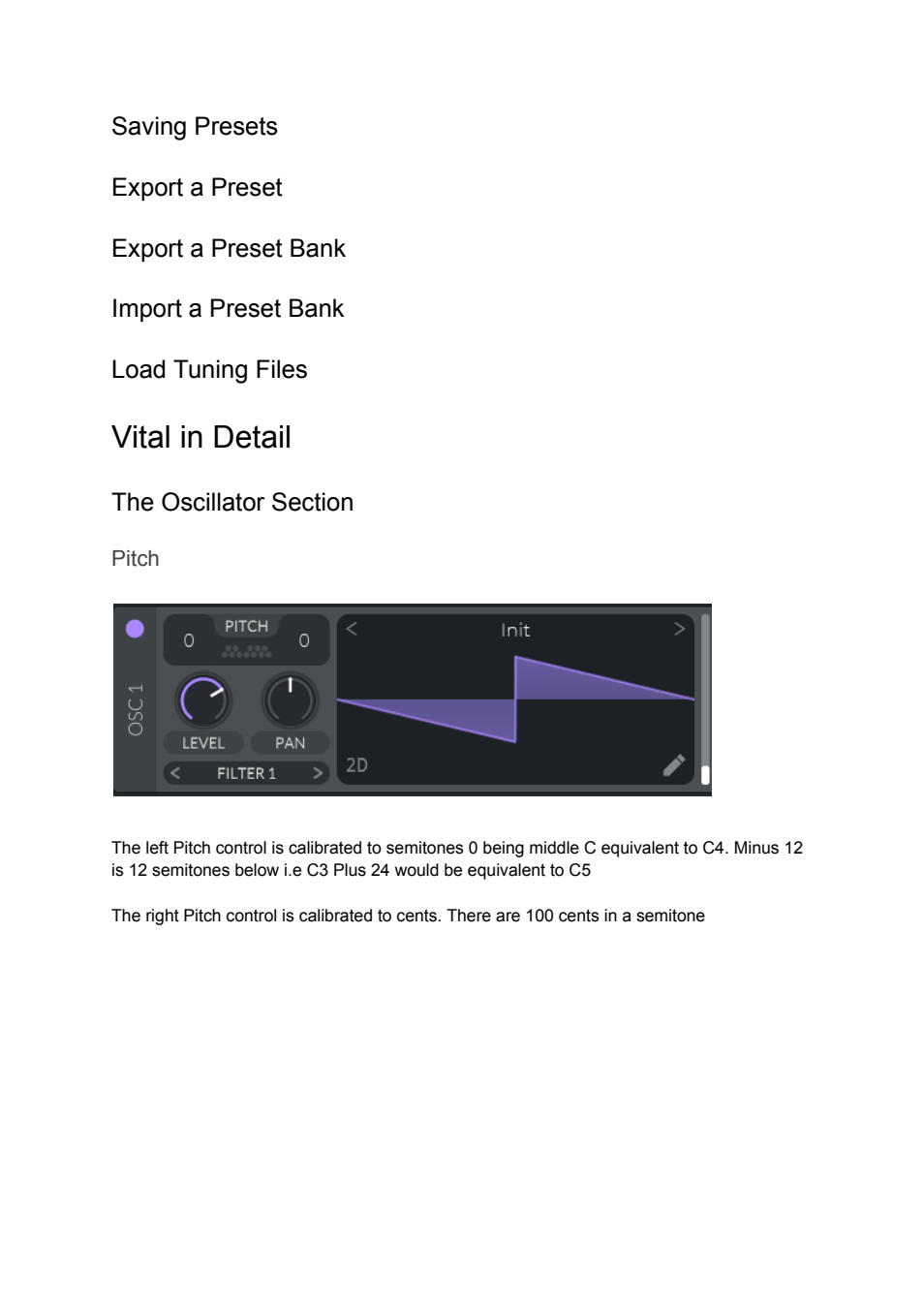
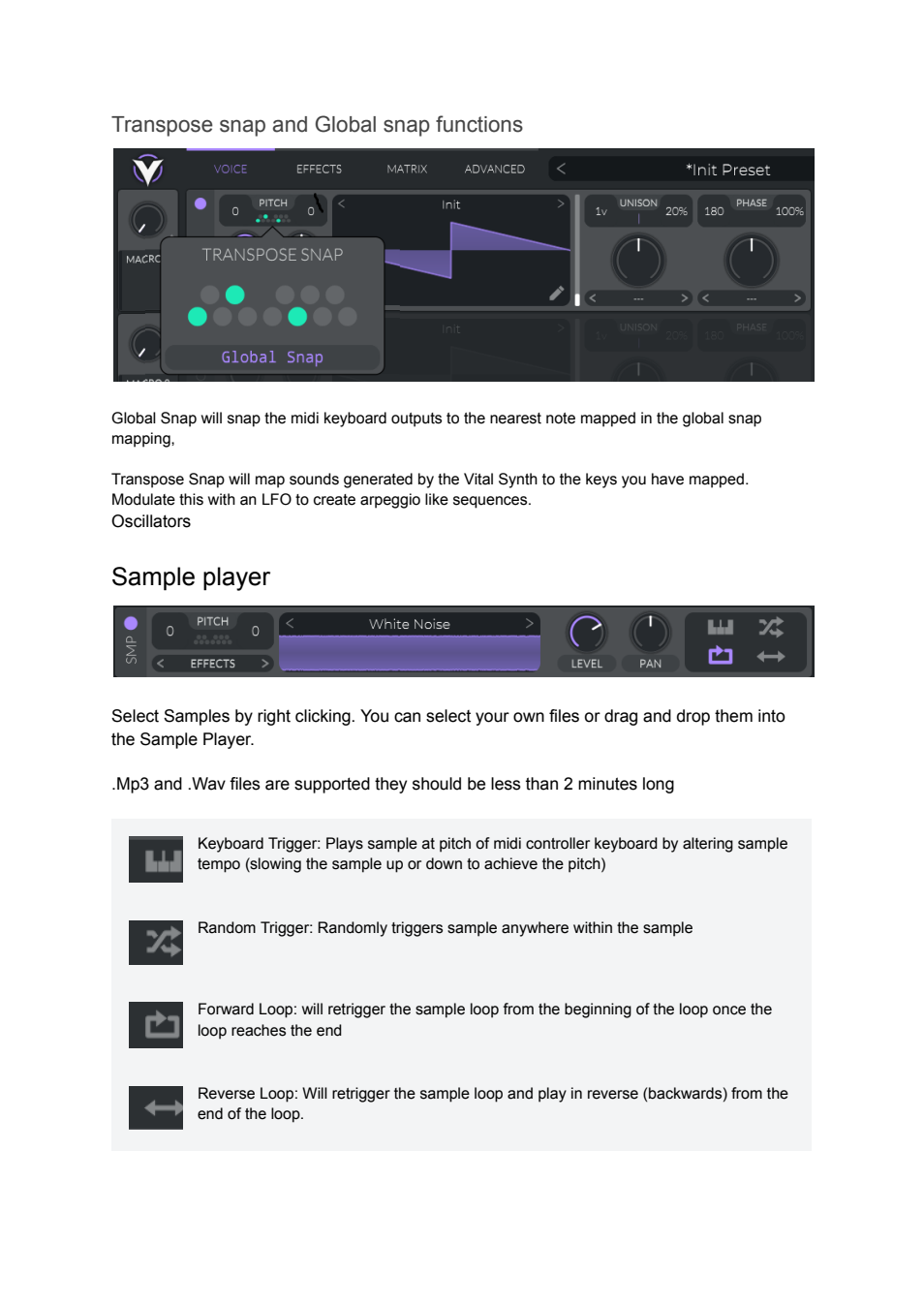
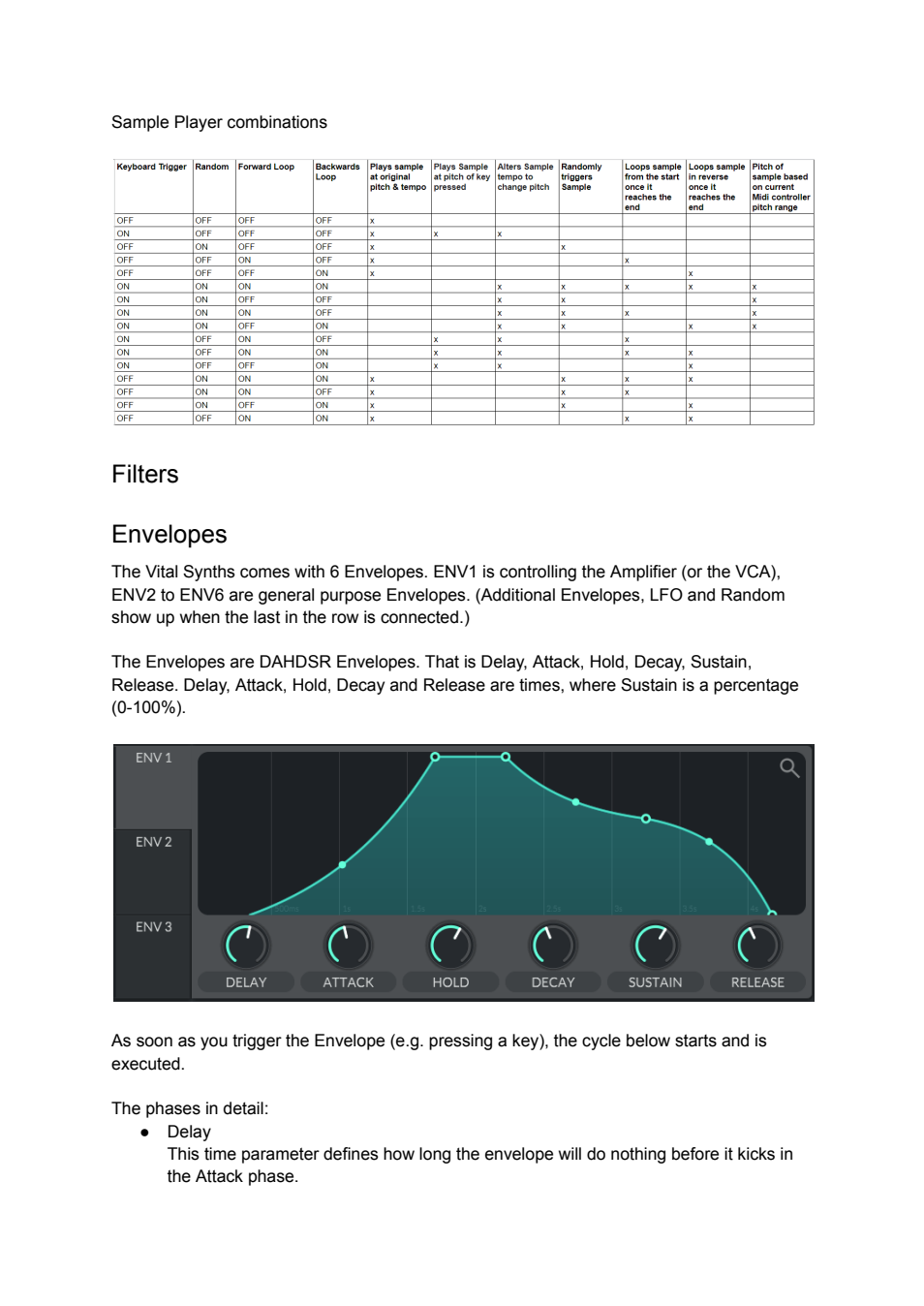
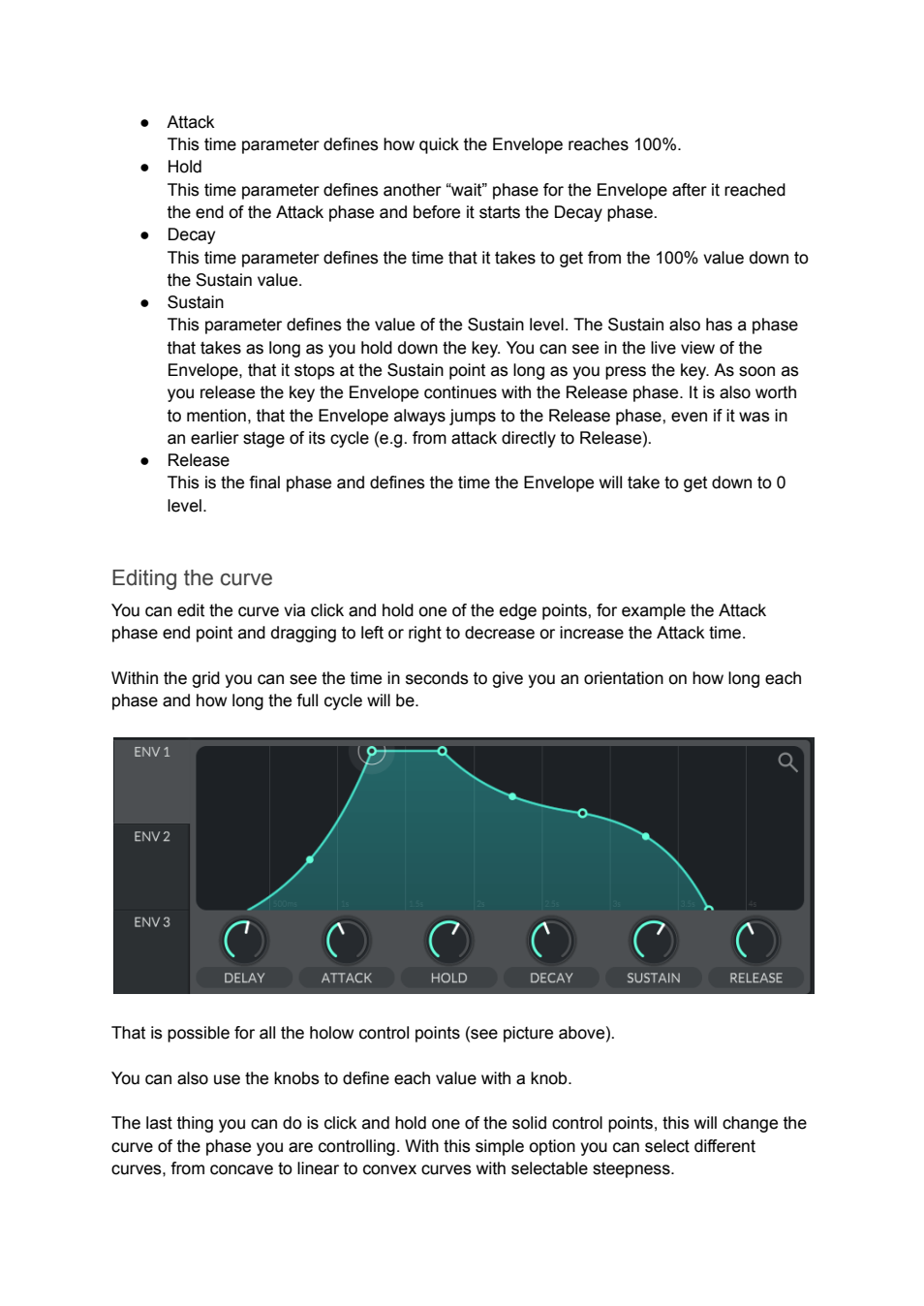
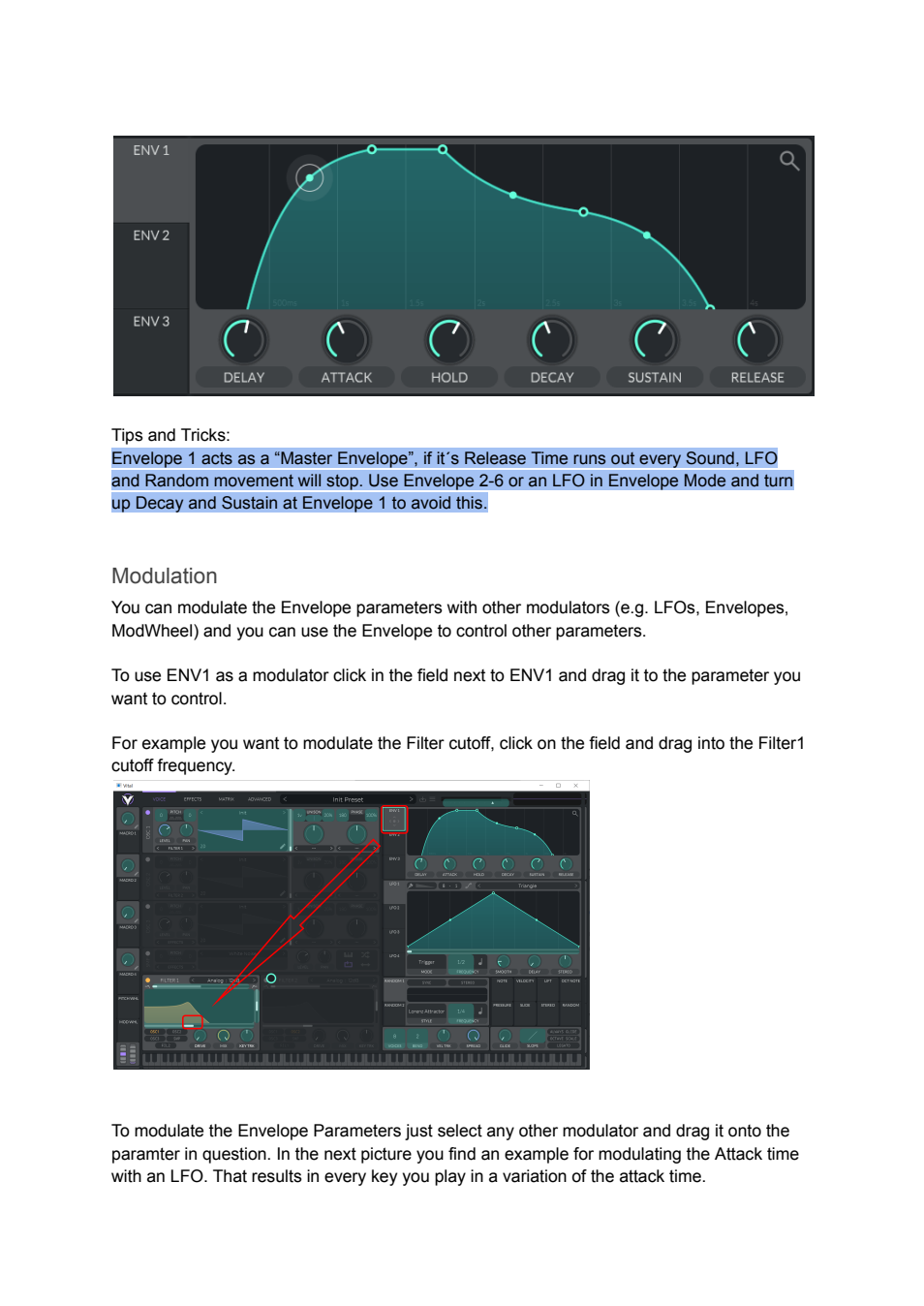
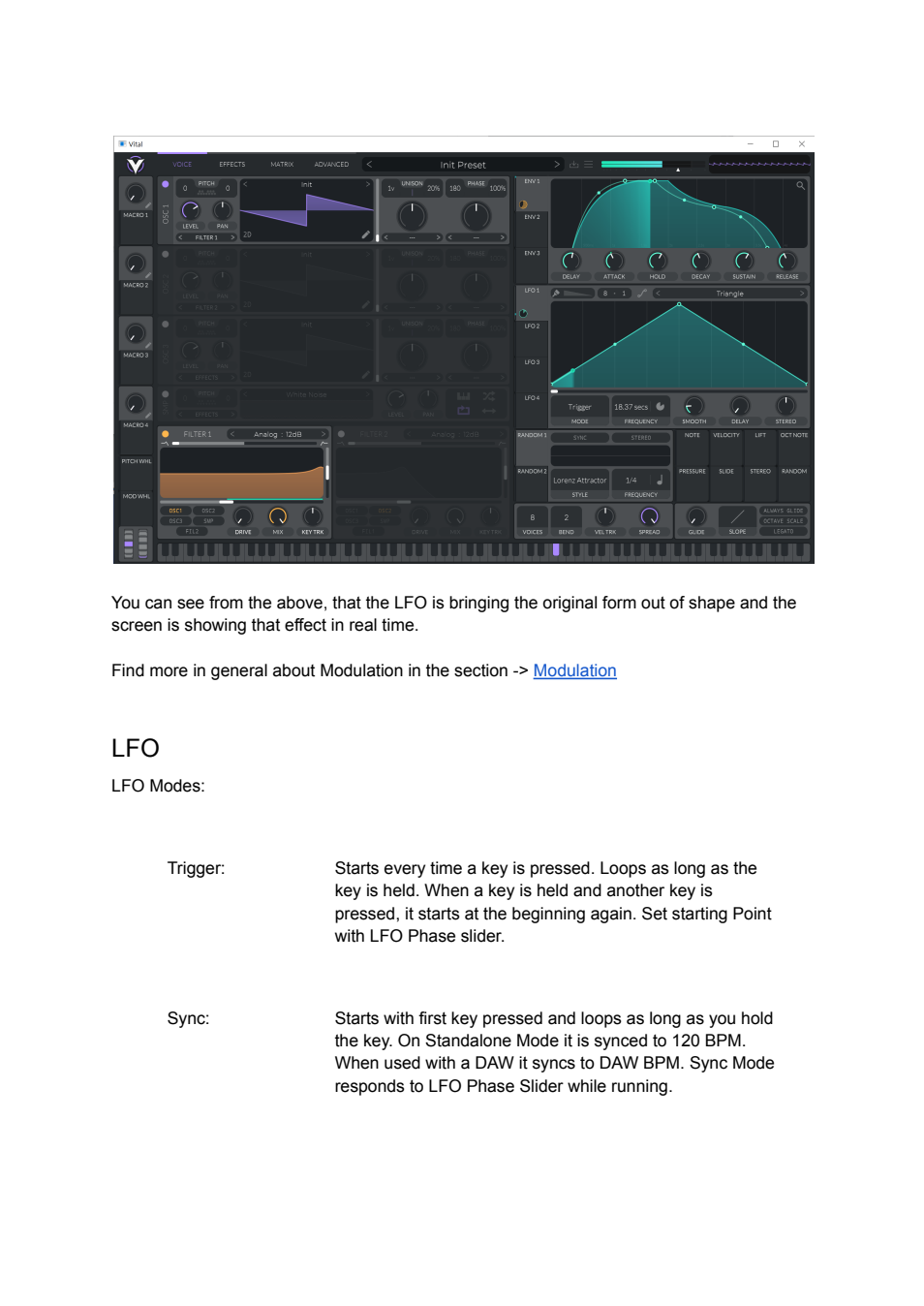
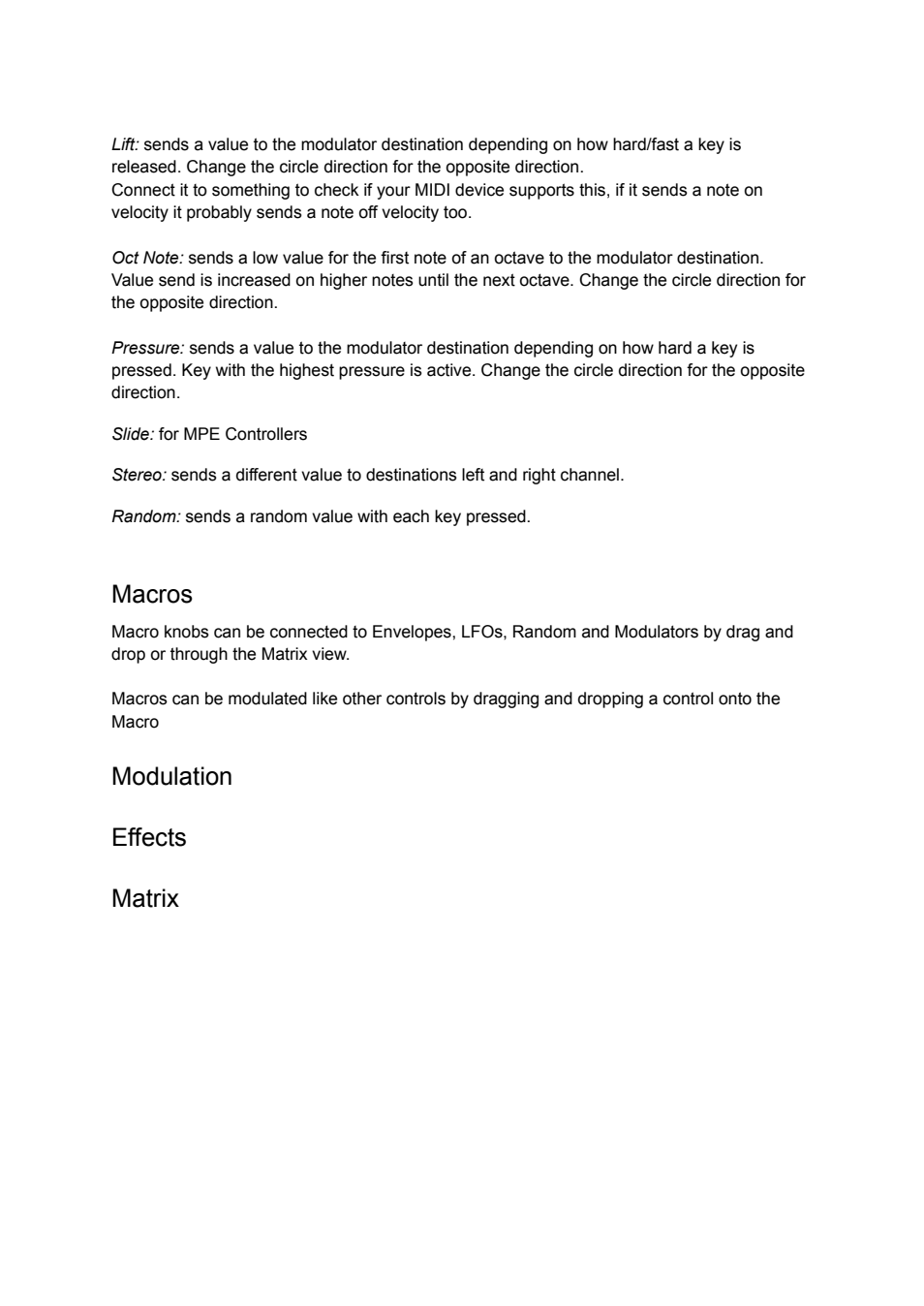
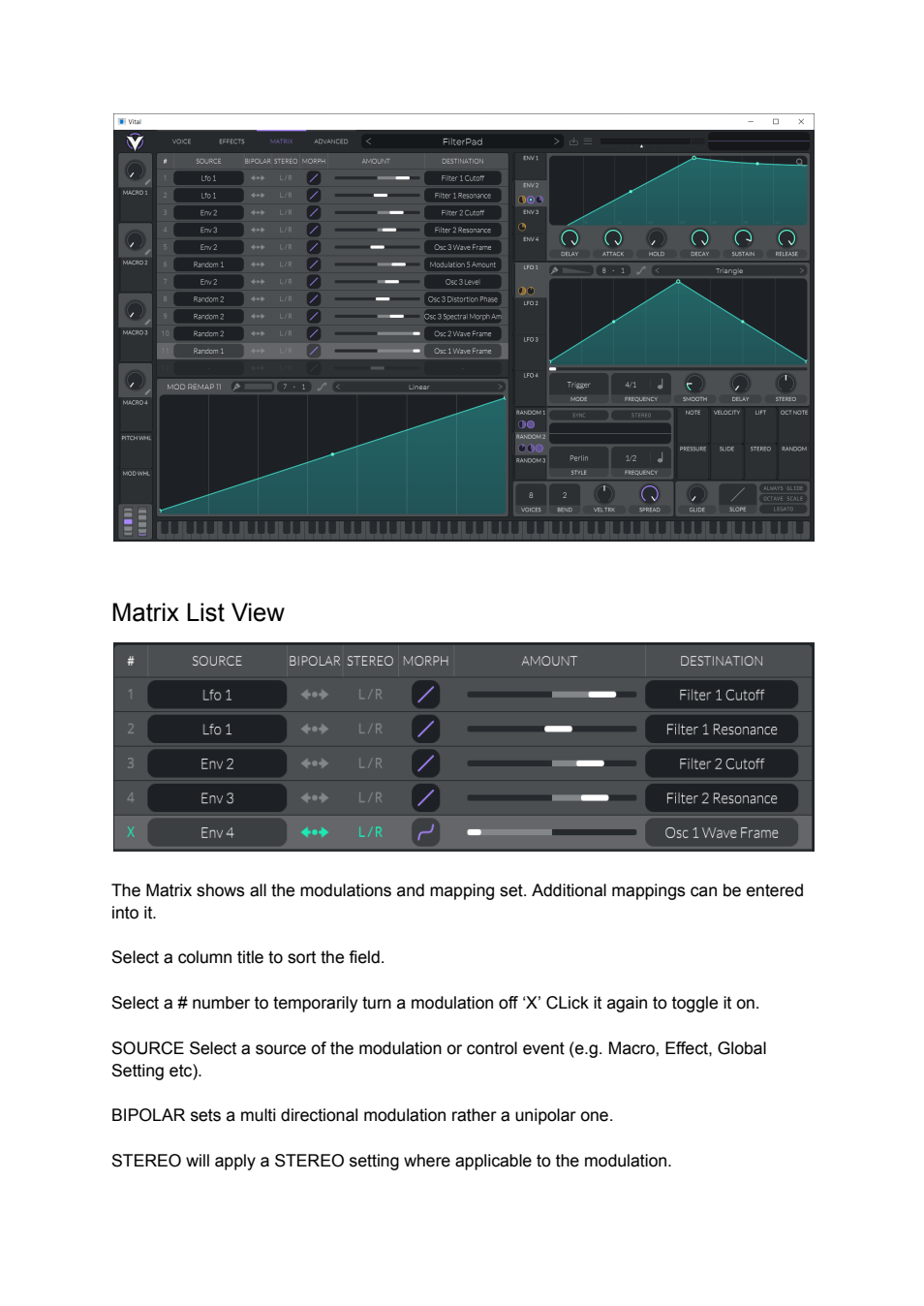
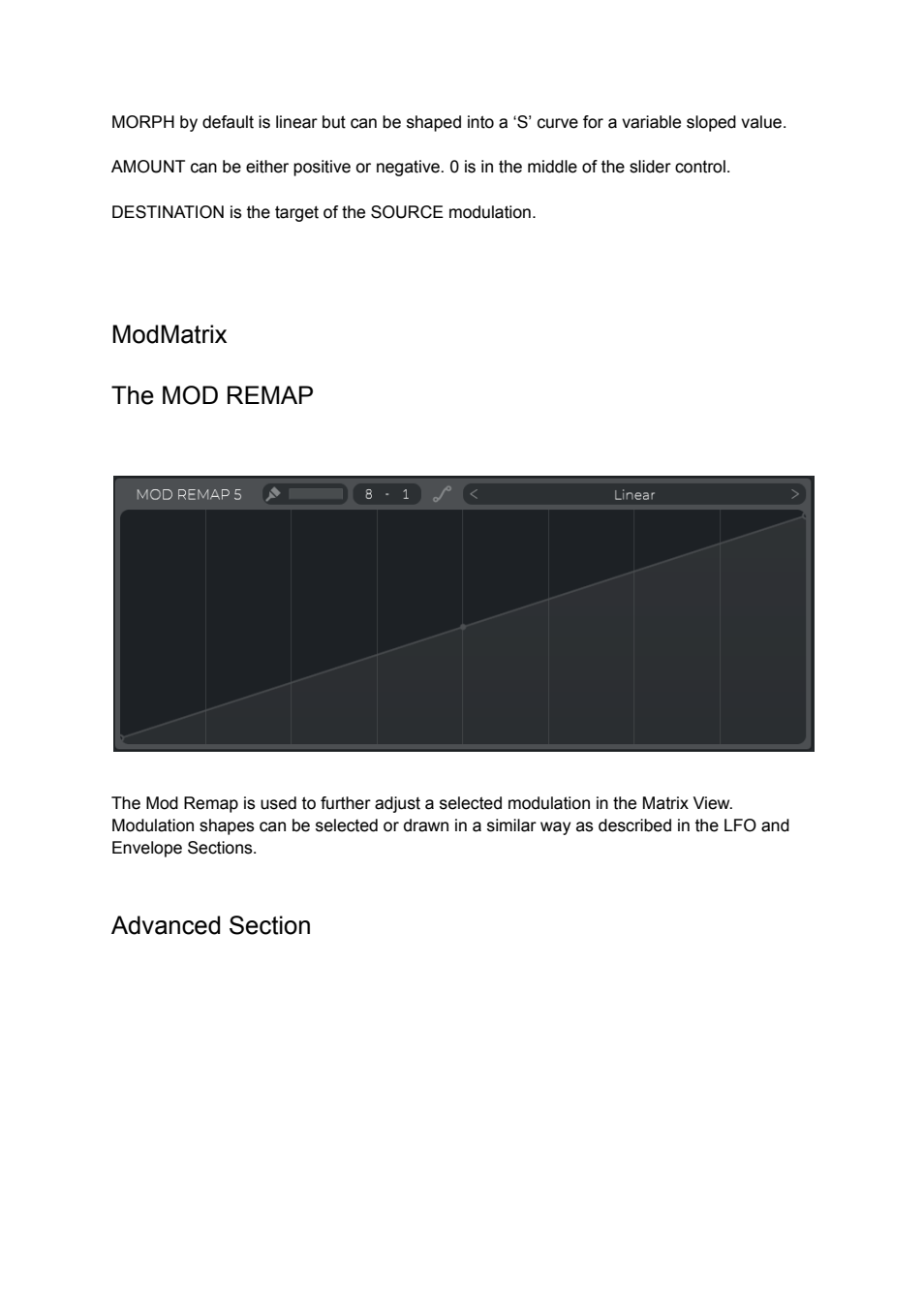
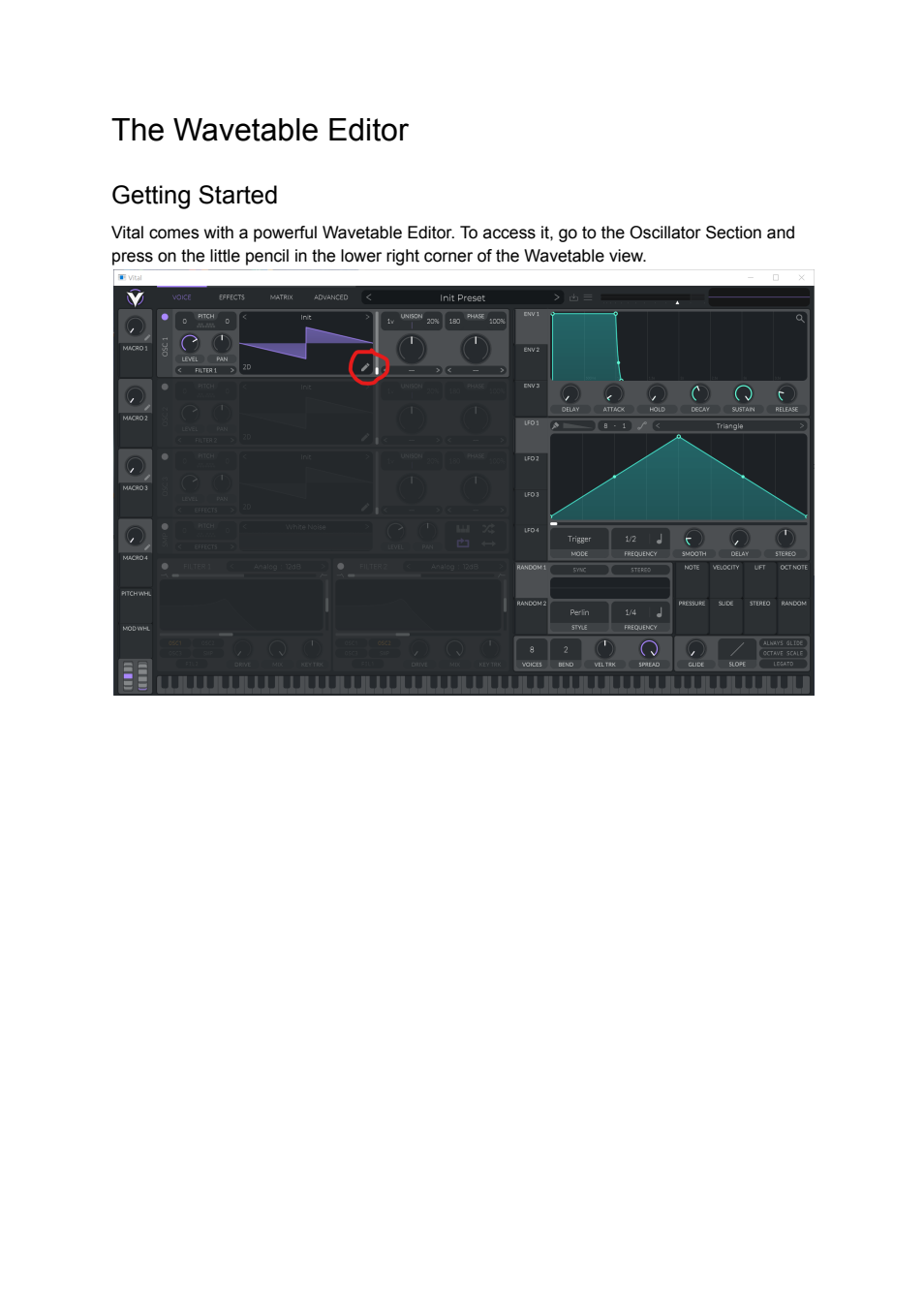
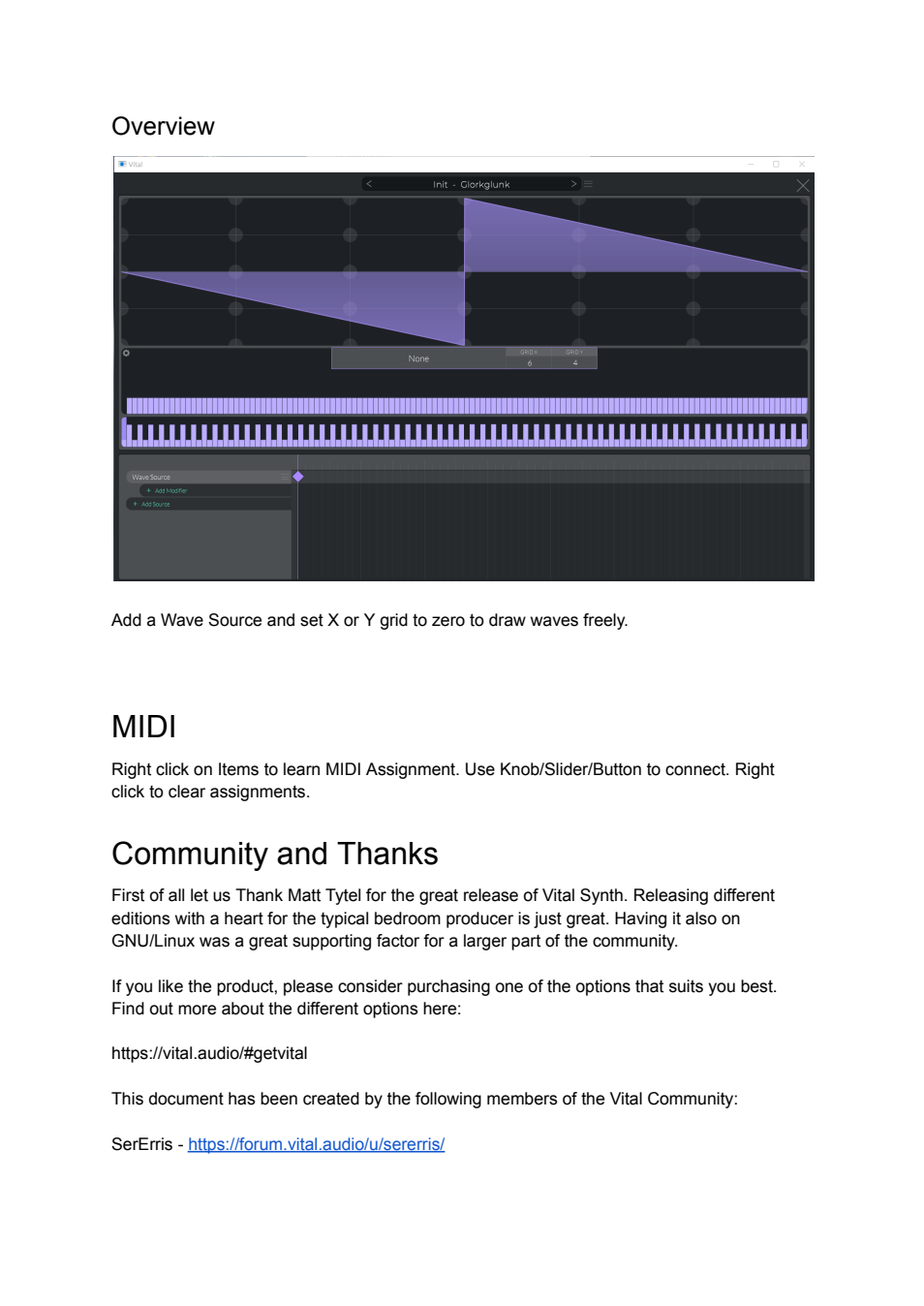
===== PDF PAGE 1 ===== The Unofficial Vital Documentation Community Edition For the Vital Synth created and © by Matt Tytel This is the community documentation created by members of the Vital Community For more information on Vital and the official Vital documentation and Support pls visit https://vital.audio/ or https://forum.vital.audio/ ===== PDF PAGE 2 ===== Disclaimer This document is in no way connected, sponsored, paid or in any other way part of the official vital.audio product. It is a use at your own risk documentation from friendly people on the internet to get you started. This document has been created with the blessing from Matt Tytel. However it does not get any official support or has any input from Matt. In other words: Do not approach Matt or the official Support channel for any updates on this document. USE AT YOUR OWN RISK! How can I get Support? Go to the Vital Forums. There you can get official Support to the product if anything within the product does not work and also you can get support from the very helpful community. The official forum is here: https://forum.vital.audio How can I help with this documentation? If you want to contribute, you can ask to get access - right here in the top right corner. However it is recommended you come into this thread and tell us about it: https://forum.vital.audio/t/vital-community-documentation/5206 Also if you like to leave feedback or guide this team on things you like to learn/know - use the same thread above to discuss. ===== PDF PAGE 3 ===== Introduction 3 Key Features 3 About This Manual 3 Vital Synth Editions 3 System Requirements 3 Installation and Startup 3 Gettings Started 3 Screen Overview 3 Settings 3 Browsing Presets 3 Favorites 4 Your own Presets 5 Importing a Preset Bank 6 Adding Presets Files from Other users 7 Initialize Preset 10 Saving Presets 12 Export a Preset 12 Export a Preset Bank 12 Import a Preset Bank 12 Load Tuning Files 12 Vital in Detail 12 Oscillators 12 Sample player 12 Filters 12 Envelopes 12 LFOs 12 Random Generators 12 Modulators 12 Macros 12 Modulation 12 Effects 12 ModMatrix 12 Advanced Section 12 The Wavetable Editor 13 Getting Started 13 Overview 14 Community and Thanks 14 ===== PDF PAGE 4 ===== Introduction Key Features About This Manual Vital Synth Editions Actual Version is 1.0.7 (17. Feb. 2021) https://account.vital.audio/ for manual download, click all downloads for older versions. System Requirements Vital is supported on the following platforms: Windows: 10x64 1909 and higher MacOS: 10.12 and higher Ubuntu Linux 18.04 and above System Requirements: 64 bit only OpenGL 3 or higher However Vital is also known to run but not supported on older/other systems. Not supported means, please do not ask for support on the official support line if you run it on anything else then the supported systems. The following systems are known to be able to run it. Windows 7, Windows 8 Some other Linux Derivates - many with issues. The community may be able to help, but do not expect any official support for those. Installation and Startup Just download the Software and install it via the installer. Windows: Run the VitalInstaller.exe and select how you want to install it. It can be installed as VST2, VST3 and/or standalone. Then click next. ===== PDF PAGE 5 ===== In the next window you can choose the installation path and the VST path. Defaults typically work well. MacOS Linux First Start On First start of the Vital application, you are asked to enter your credentials. That are the same credentials you used to register on the vital.audio site to download. After entering the credentials the Vital screen will come up and the downloads for your Edition will start. After the downloads are finished click install and the presets and wavetables will get installed. Gettings Started Screen Overview Settings Click on the Vital sign at the top left corner to enter settings. ===== PDF PAGE 6 ===== Inside you can change the following parameters: ● see Version Number ● set automatic update flags This checks for updates automatically on the next start of Vital ● set UI size Here you can adjust the screen scaling for hiDPI screen ===== PDF PAGE 7 ===== ● select Audio Device Currently you cannot select ASIO devices specifically. But Windows Audio works best on Windows. ● select Output Select the Output channel of the Audio Device here, if you have multiple. ● Click Test to check if Audio Setup is working ● select Sample Rate This defaults to the system audio rate and should stay that way. If it is different than your system audio rate, change it to the same setting, (e.g. 44.1khz) ● select Audio Buffer Size As for every VST smaller buffers mean lower latency, but also increase the chance of crackling or disruption in the sound stream and also results in higher CPU load. A good mixture between both settings is advised. ● select MIDI Inputs Vital responds to all 16 Channels There is currently a bug in the 1.05 release that does not save this setting. On the next start everything is back to default. Browsing Presets To browse the presets, just click on the preset name (“Init Preset” in the picture) or click the three lines and select “Browse Presets”. You can also just move through the presets by clicking on the arrows left and right of the preset name. After you open up the preset browser you can filter and browse via folders. It is pretty much self explanatory. ===== PDF PAGE 8 ===== You can filter by selecting the Preset category (such as Pad, Lead Keys or others). You can add multiple categories which shows all of the categories. You can also select a specific Preset Set (e.g. Folder on your computer) and filter in there, or you can select ALL or Favorites. In addition you can search for Presets by entering any string in the Search line. This will filter the Presets that either match the Name of the preset or the Author. ● When a preset is changed by mouse click, stay with the mouse on the arrow and use the return key to change presets. (Works on most clickable items too.) ● When the Preset Browser is open, use arrow keys to change Presets. Stops working when clicked somewhere else. Favorites You can add individual Presets to your Favorites list, by activating the star in front of a Patch Name. That will make it easier to find the patches you like. ===== PDF PAGE 9 ===== Your own Presets If you create presets and save them, they will show up under the “User” folder. Vital will always fill in the last used name as author when presets are saved. So when the save button is used to see the comments it shows not the real author. You can actually create a patch bundle and save it under a different name. The simple way is to create a subfolder in the your Vital Documents folder: ● Windows: (C:\Users\YourUserName\Documents\Vital) ===== PDF PAGE 10 ===== ● MacOS: ● Linux: Then copy/move the patches you want to have in that folder to the newly created folder and they will show up after the next restart of Vital. Importing a Preset Bank You can find presets in many different forums online from other users for free or for purchase. The community has created some presets, which you can find here and download for free: https://forum.vital.audio/t/february-2021-free-patch-sharing-thread/5074 So lets assume we want to import the first free preset bank November 2020 Free Patch Sharing Thread.vitalbank 1. Download the bank. It will save a file “November 2020 Free Patch Sharing Thread.vitalbank” to your download folder. 2. Now open Vital and click the three lines next to the patch name (options) and select “Import Preset Bank” 3. A browser Windows opens. Go to your Downloads folder and select the downloaded .vitalbank file and click “open” ===== PDF PAGE 11 ===== 4. After you imported the bank, a new folder will show up in your preset library with the name of the import bank file “November 2020 Free Patch Sharing Thread”. You can now browse the patches as usual. For more information go -> Browsing Presets Adding Presets Files from Other users Even if Preset sharing is preferred as Banks, there is another way to import Presets into your library. They are organized as a file structure packed in a .zip or .rar file. These Preset bundles require a different way of installation. After you downloaded the pack, you will typically have a .zip or .rar file. Use the following steps to import the pack into Vital: 1. Unrar / Unzip (you can use the free 7-Zip or WinRar ) the Soundbank Files (Use - Right-click unpack here) ===== PDF PAGE 12 ===== 2. Within the unpacked directory, you will find a directory with the name of the preset/wavetable bundle (in this example “Sonic Sirius”). 3. This folder typically contains a “preset” subfolder but also main contain a “LFO” or “wavetables” folders. ===== PDF PAGE 13 ===== Copy & Paste the top level folder that contains the preset … subfolders into: ===== PDF PAGE 14 ===== ○ (Windows Example) C:\Users\YourName\Documents\Vital ○ (MacOS Example) ○ (Linux Example) 4. Load the Vital Spectral Instrument in your Digital Audio Workstation (DAW) or load the standalone Vital Version - for detailed instruction go -> Browsing Presets Initialize Preset WARNING: THIS WILL ERASE ALL UNSAVED CHANGES YOU MAY HAVE MADE BEFORE WITHOUT ASKING. SAVE YOUR WORK BEFORE INITIALIZING THE PRESET. ===== PDF PAGE 15 ===== This is a special function to start from scratch with your Preset creation. Just go to the top of the Vital window and click the three lines (options). Then select “Initialize Preset”. Now you have a fresh, clean new Preset. ===== PDF PAGE 16 ===== Saving Presets Export a Preset Export a Preset Bank Import a Preset Bank Load Tuning Files Vital in Detail The Oscillator Section Pitch The left Pitch control is calibrated to semitones 0 being middle C equivalent to C4. Minus 12 is 12 semitones below i.e C3 Plus 24 would be equivalent to C5 The right Pitch control is calibrated to cents. There are 100 cents in a semitone ===== PDF PAGE 17 ===== Transpose snap and Global snap functions Global Snap will snap the midi keyboard outputs to the nearest note mapped in the global snap mapping, Transpose Snap will map sounds generated by the Vital Synth to the keys you have mapped. Modulate this with an LFO to create arpeggio like sequences. Oscillators Sample player Select Samples by right clicking. You can select your own files or drag and drop them into the Sample Player. .Mp3 and .Wav files are supported they should be less than 2 minutes long Keyboard Trigger: Plays sample at pitch of midi controller keyboard by altering sample tempo (slowing the sample up or down to achieve the pitch) Random Trigger: Randomly triggers sample anywhere within the sample Forward Loop: will retrigger the sample loop from the beginning of the loop once the loop reaches the end Reverse Loop: Will retrigger the sample loop and play in reverse (backwards) from the end of the loop. ===== PDF PAGE 18 ===== Sample Player combinations Filters Envelopes The Vital Synths comes with 6 Envelopes. ENV1 is controlling the Amplifier (or the VCA), ENV2 to ENV6 are general purpose Envelopes. (Additional Envelopes, LFO and Random show up when the last in the row is connected.) The Envelopes are DAHDSR Envelopes. That is Delay, Attack, Hold, Decay, Sustain, Release. Delay, Attack, Hold, Decay and Release are times, where Sustain is a percentage (0-100%). As soon as you trigger the Envelope (e.g. pressing a key), the cycle below starts and is executed. The phases in detail: ● Delay This time parameter defines how long the envelope will do nothing before it kicks in the Attack phase. ===== PDF PAGE 19 ===== ● Attack This time parameter defines how quick the Envelope reaches 100%. ● Hold This time parameter defines another “wait” phase for the Envelope after it reached the end of the Attack phase and before it starts the Decay phase. ● Decay This time parameter defines the time that it takes to get from the 100% value down to the Sustain value. ● Sustain This parameter defines the value of the Sustain level. The Sustain also has a phase that takes as long as you hold down the key. You can see in the live view of the Envelope, that it stops at the Sustain point as long as you press the key. As soon as you release the key the Envelope continues with the Release phase. It is also worth to mention, that the Envelope always jumps to the Release phase, even if it was in an earlier stage of its cycle (e.g. from attack directly to Release). ● Release This is the final phase and defines the time the Envelope will take to get down to 0 level. Editing the curve You can edit the curve via click and hold one of the edge points, for example the Attack phase end point and dragging to left or right to decrease or increase the Attack time. Within the grid you can see the time in seconds to give you an orientation on how long each phase and how long the full cycle will be. That is possible for all the holow control points (see picture above). You can also use the knobs to define each value with a knob. The last thing you can do is click and hold one of the solid control points, this will change the curve of the phase you are controlling. With this simple option you can select different curves, from concave to linear to convex curves with selectable steepness. ===== PDF PAGE 20 ===== Tips and Tricks: Envelope 1 acts as a “Master Envelope”, if it´s Release Time runs out every Sound, LFO and Random movement will stop. Use Envelope 2-6 or an LFO in Envelope Mode and turn up Decay and Sustain at Envelope 1 to avoid this. Modulation You can modulate the Envelope parameters with other modulators (e.g. LFOs, Envelopes, ModWheel) and you can use the Envelope to control other parameters. To use ENV1 as a modulator click in the field next to ENV1 and drag it to the parameter you want to control. For example you want to modulate the Filter cutoff, click on the field and drag into the Filter1 cutoff frequency. To modulate the Envelope Parameters just select any other modulator and drag it onto the paramter in question. In the next picture you find an example for modulating the Attack time with an LFO. That results in every key you play in a variation of the attack time. ===== PDF PAGE 21 ===== You can see from the above, that the LFO is bringing the original form out of shape and the screen is showing that effect in real time. Find more in general about Modulation in the section -> Modulation LFO LFO Modes: Trigger: Starts every time a key is pressed. Loops as long as the key is held. When a key is held and another key is pressed, it starts at the beginning again. Set starting Point with LFO Phase slider. Sync: Starts with first key pressed and loops as long as you hold the key. On Standalone Mode it is synced to 120 BPM. When used with a DAW it syncs to DAW BPM. Sync Mode responds to LFO Phase Slider while running. ===== PDF PAGE 22 ===== Envelope: Starts every time a key is pressed. Runs one time to the end or until key is released. Keeps the value of end point when key is held, restarts if another key is pressed. Set Start Point with LFO Phase Slider. Sustain Envelope: Starts when a key is released and runs until release time is over. If LFO Phase Slider is moved it starts with key press, stops at Slider position and restarts at release to end point or time out. Loop Point: Starts when a key is pressed. Runs as long as key is held or release time runs out. LFO Phase Slider set start point for second and later cycles. Loop Hold: Starts when key is released, keeps last value until release time out. When LFO Phase Slider is moved it loops from start to Slider position when key is held and on release one cycle from start to end runs through. In the “Note” modes LFO frequency can be set to freeze, then connected and started with another modulator. In Standalone Version Vital is set to 120 BPM. When LFO Frequency is set to 1/1 one cycle is 2 seconds long. One ⅛ bar up ⅛ bar down alternated results in 120 BPM with 8 x 0,25 sec beat and pause. Random Generators Modulators Note: sends a value to the modulator destination depending on what note is played. Turn the circle clockwise to send higher value on higher notes and lower value on lower notes. Turn counterclockwise for the opposite direction. Velocity: sends a value to the modulator destination depending on how hard/fast a key is pressed. Change the circle direction for the opposite direction. ===== PDF PAGE 23 ===== Lift: sends a value to the modulator destination depending on how hard/fast a key is released. Change the circle direction for the opposite direction. Connect it to something to check if your MIDI device supports this, if it sends a note on velocity it probably sends a note off velocity too. Oct Note: sends a low value for the first note of an octave to the modulator destination. Value send is increased on higher notes until the next octave. Change the circle direction for the opposite direction. Pressure: sends a value to the modulator destination depending on how hard a key is pressed. Key with the highest pressure is active. Change the circle direction for the opposite direction. Slide: for MPE Controllers Stereo: sends a different value to destinations left and right channel. Random: sends a random value with each key pressed. Macros Macro knobs can be connected to Envelopes, LFOs, Random and Modulators by drag and drop or through the Matrix view. Macros can be modulated like other controls by dragging and dropping a control onto the Macro Modulation Effects Matrix ===== PDF PAGE 24 ===== Matrix List View The Matrix shows all the modulations and mapping set. Additional mappings can be entered into it. Select a column title to sort the field. Select a # number to temporarily turn a modulation off ‘X’ CLick it again to toggle it on. SOURCE Select a source of the modulation or control event (e.g. Macro, Effect, Global Setting etc). BIPOLAR sets a multi directional modulation rather a unipolar one. STEREO will apply a STEREO setting where applicable to the modulation. ===== PDF PAGE 25 ===== MORPH by default is linear but can be shaped into a ‘S’ curve for a variable sloped value. AMOUNT can be either positive or negative. 0 is in the middle of the slider control. DESTINATION is the target of the SOURCE modulation. ModMatrix The MOD REMAP The Mod Remap is used to further adjust a selected modulation in the Matrix View. Modulation shapes can be selected or drawn in a similar way as described in the LFO and Envelope Sections. Advanced Section ===== PDF PAGE 26 ===== The Wavetable Editor Getting Started Vital comes with a powerful Wavetable Editor. To access it, go to the Oscillator Section and press on the little pencil in the lower right corner of the Wavetable view. ===== PDF PAGE 27 ===== Overview Add a Wave Source and set X or Y grid to zero to draw waves freely. MIDI Right click on Items to learn MIDI Assignment. Use Knob/Slider/Button to connect. Right click to clear assignments. Community and Thanks First of all let us Thank Matt Tytel for the great release of Vital Synth. Releasing different editions with a heart for the typical bedroom producer is just great. Having it also on GNU/Linux was a great supporting factor for a larger part of the community. If you like the product, please consider purchasing one of the options that suits you best. Find out more about the different options here: https://vital.audio/#getvital This document has been created by the following members of the Vital Community: SerErris - https://forum.vital.audio/u/sererris/ ===== PDF PAGE 28 ===== vcvr - https://forum.vital.audio/u/vcvr/ Andy Pettitt https://forum.vital.audio/u/andypettitt70

C01 | Community manual / Page 1

Vital community documentation.pdf | Page 1 | documentation and visible configuration; not a new native test

C01 Community manual / Page 1
Community manual / Page 1

Retained observation

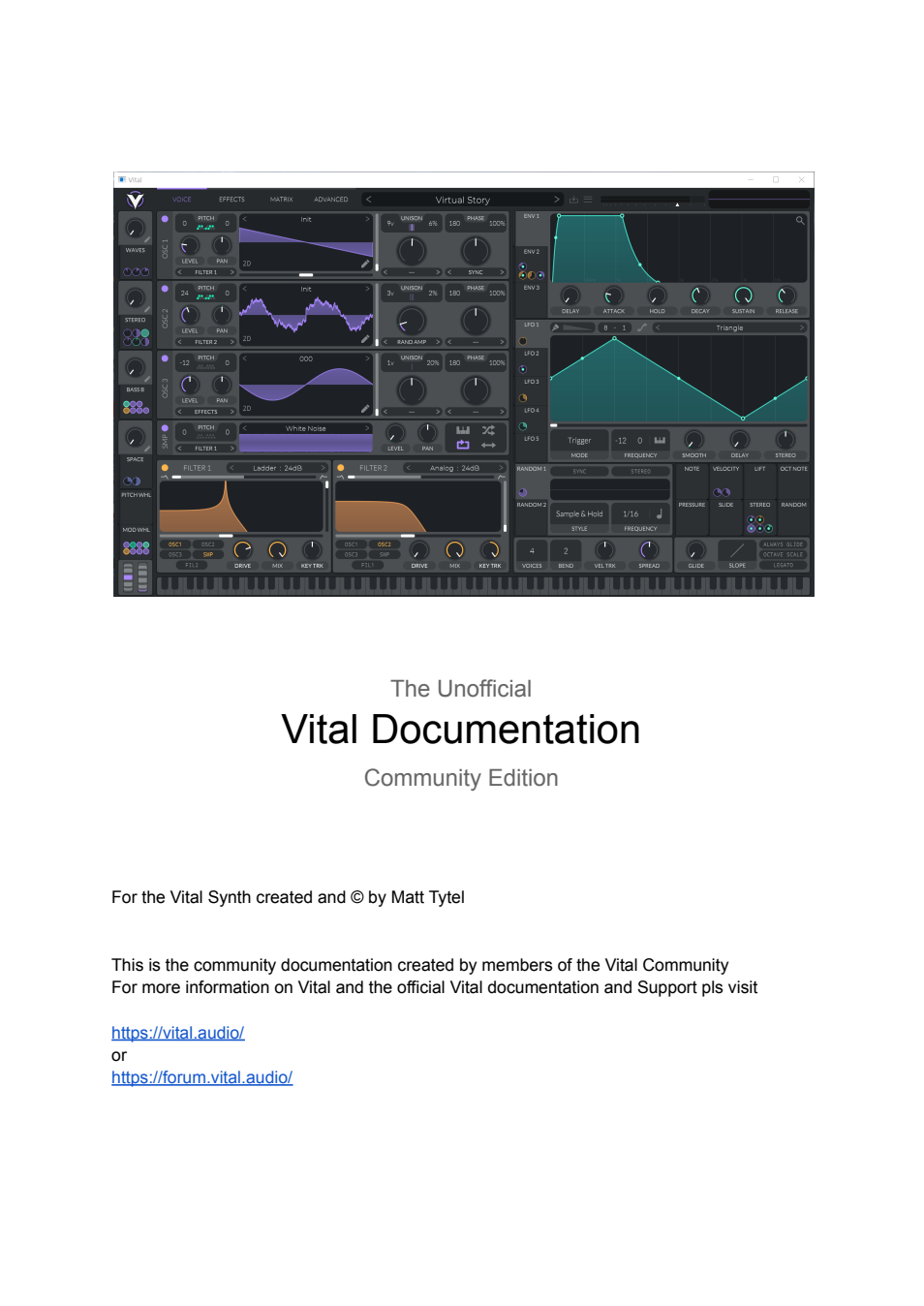
The cover uses a complete multi-oscillator patch with both filters and several modulator assignments. It introduces the full instrument surface, not a minimal wavetable-only workflow. The patch is an illustration, not reference truth.

Source SHA-256: 46c9e2d8abcf2f0ff15e6e72cb66a23e4fd8ea0767ad23a23902d836055beac5
Image SHA-256: 20bc626159849b10c911e5e32a057d11ef60dc4c44d4c5210fe53c25d7ce331c

C02 | Community manual / Page 2

Vital community documentation.pdf | Page 2 | documentation and visible configuration; not a new native test

C02 Community manual / Page 2
Community manual / Page 2

Retained observation

This is a community-authored document with support/credit links, not official binary documentation. Preserve the source provenance without devaluing its practical controls. No contact or contribution request was performed.

Source SHA-256: 46c9e2d8abcf2f0ff15e6e72cb66a23e4fd8ea0767ad23a23902d836055beac5
Image SHA-256: 08d9f73f9c98d69c20a90f92209970142e3405f1ffffd36ee3d1a018ce433290

C03 | Community manual / Page 3

Vital community documentation.pdf | Page 3 | documentation and visible configuration; not a new native test

C03 Community manual / Page 3
Community manual / Page 3

Retained observation

The contents include preset handling, oscillator/sample/filter controls, envelopes, LFOs, matrix and editor. Some sections later contain placeholders; their absence is a documentation gap, not missing functionality in Vital.

Source SHA-256: 46c9e2d8abcf2f0ff15e6e72cb66a23e4fd8ea0767ad23a23902d836055beac5
Image SHA-256: 8e2643e1ca1af97a6258cb9b907c9cb6b3a9cf1f06bc263f0df590e0c00c7fb9

C04 | Community manual / Page 4

Vital community documentation.pdf | Page 4 | documentation and visible configuration; not a new native test

C04 Community manual / Page 4
Community manual / Page 4

Retained observation

The version/system text is dated to Vital 1.0.7 in 2021. Keep date and platform context when using installation examples; do not change our environment to match them. This page contains no synthesis diagram.

Source SHA-256: 46c9e2d8abcf2f0ff15e6e72cb66a23e4fd8ea0767ad23a23902d836055beac5
Image SHA-256: 37f48a60acee9c405c6d6d69b8e1280e16e96af963f797d5f5ff21942b791860

C05 | Community manual / Page 5

Vital community documentation.pdf | Page 5 | documentation and visible configuration; not a new native test

C05 Community manual / Page 5
Community manual / Page 5

Retained observation

The Windows installer screenshot separates standalone, VST and VST3 components. It is an installation example, not evidence about our installed Mac host or a reason to reinstall. Retained as operational context.

Source SHA-256: 46c9e2d8abcf2f0ff15e6e72cb66a23e4fd8ea0767ad23a23902d836055beac5
Image SHA-256: c5b2c9e4b9111df3e4dc0eb8b4a63cc4a54399805ff954e8b7d733280c01f6bf

C06 | Community manual / Page 6

Vital community documentation.pdf | Page 6 | documentation and visible configuration; not a new native test

C06 Community manual / Page 6
Community manual / Page 6

Retained observation

The marked Vital logo opens a panel with version, UI scale, audio device, sample rate/buffer and MIDI inputs. These settings explain how a live standalone session is connected; they are not equivalent to saved sound parameters.

Source SHA-256: 46c9e2d8abcf2f0ff15e6e72cb66a23e4fd8ea0767ad23a23902d836055beac5
Image SHA-256: 071ddd7d88e63ee57947b282cf0dc4088f4b9b7f05b51cfcc40e3f6035520388

C07 | Community manual / Page 7

Vital community documentation.pdf | Page 7 | documentation and visible configuration; not a new native test

C07 Community manual / Page 7
Community manual / Page 7

Retained observation

The main menu gives a route to the preset browser. The accompanying buffer/rate discussion distinguishes audio-host problems from synthesis. Capture the active host configuration when investigating glitches; an old version-specific settings bug is not automatically a present failure.

Source SHA-256: 46c9e2d8abcf2f0ff15e6e72cb66a23e4fd8ea0767ad23a23902d836055beac5
Image SHA-256: 3a21cbe8fb07f1e3c5e201b59e6e59f4acc421a4a7dfe2530a84949edbdb59b6

C08 | Community manual / Page 8

Vital community documentation.pdf | Page 8 | documentation and visible configuration; not a new native test

C08 Community manual / Page 8
Community manual / Page 8

Retained observation

The browser shows folder/category filters, search, favorites and metadata. These are retrieval tools for retaining working ingredients and complete patches, not an acoustic similarity engine. Categories do not prove a sound's mechanism.

Source SHA-256: 46c9e2d8abcf2f0ff15e6e72cb66a23e4fd8ea0767ad23a23902d836055beac5
Image SHA-256: 1cebb712f6ec3b147e9367e0e87f4a9e1c702ef5e3dd707dcc071baa5609576e

C09 | Community manual / Page 9

Vital community documentation.pdf | Page 9 | documentation and visible configuration; not a new native test

C09 Community manual / Page 9
Community manual / Page 9

Retained observation

User/factory folders and preset metadata appear separately. Preserving original identity and a research copy prevents experiments overwriting the source. The author-field warning is historical UI behavior, not a license/provenance fact.

Source SHA-256: 46c9e2d8abcf2f0ff15e6e72cb66a23e4fd8ea0767ad23a23902d836055beac5
Image SHA-256: 289054c5618086c0ffed7147dd8713b8327828b11596749f88935963753fa6e2

C10 | Community manual / Page 10

Vital community documentation.pdf | Page 10 | documentation and visible configuration; not a new native test

C10 Community manual / Page 10
Community manual / Page 10

Retained observation

The Import Bank command and its menu position are highlighted. A bank packages presets/resources; it is not the same operation as loading one external preset. No bank installation was performed in this review.

Source SHA-256: 46c9e2d8abcf2f0ff15e6e72cb66a23e4fd8ea0767ad23a23902d836055beac5
Image SHA-256: fcd1c36f7904f3e2bff06f312b33e2b0206f49473d583fbfab5026b4697c43b4

C11 | Community manual / Page 11

Vital community documentation.pdf | Page 11 | documentation and visible configuration; not a new native test

C11 Community manual / Page 11
Community manual / Page 11

Retained observation

The bank file picker illustrates the .vitalbank route; following text introduces ordinary archive bundles. Retain packaging distinctions for future editable delivery, without interpreting an archive's presence as successful native load.

Source SHA-256: 46c9e2d8abcf2f0ff15e6e72cb66a23e4fd8ea0767ad23a23902d836055beac5
Image SHA-256: d0bc4468c0ca048d4c5d64a8a5ffa0d54fbb6b4f02c3f6766a2f3d314f515905

C12 | Community manual / Page 12

Vital community documentation.pdf | Page 12 | documentation and visible configuration; not a new native test

C12 Community manual / Page 12
Community manual / Page 12

Retained observation

File-manager screenshots show extraction of a bundle and its top-level folder. The useful operational lesson is retaining the bundle hierarchy and dependencies. These are source screenshots, not access to the owner's unrelated directories.

Source SHA-256: 46c9e2d8abcf2f0ff15e6e72cb66a23e4fd8ea0767ad23a23902d836055beac5
Image SHA-256: 911a09caeb8a59ec9a16f4dbce79ad7fa646aa15a7b483df9c3e8a7d6d824ccb

C13 | Community manual / Page 13

Vital community documentation.pdf | Page 13 | documentation and visible configuration; not a new native test

C13 Community manual / Page 13
Community manual / Page 13

Retained observation

The example folder contains LFOs and Presets. A reusable resource collection can contain more than patch files; motion shapes merit preservation too. This does not require every exported instrument to depend on external LFO files.

Source SHA-256: 46c9e2d8abcf2f0ff15e6e72cb66a23e4fd8ea0767ad23a23902d836055beac5
Image SHA-256: fb5665753b0cd4464bfe1d879870349d91fa12923b6f8831b1d3c53b776f35e9

C14 | Community manual / Page 14

Vital community documentation.pdf | Page 14 | documentation and visible configuration; not a new native test

C14 Community manual / Page 14
Community manual / Page 14

Retained observation

The library root receives the top-level bundle. A red warning notes that Initialize discards unsaved state. Use research copies and save current state before deliberate resets; no live reset was done here.

Source SHA-256: 46c9e2d8abcf2f0ff15e6e72cb66a23e4fd8ea0767ad23a23902d836055beac5
Image SHA-256: 61781ad0a0cbc3fa6c7f600989f7a36c02eb6180e987aa0a6f1523549932b0d2

C15 | Community manual / Page 15

Vital community documentation.pdf | Page 15 | documentation and visible configuration; not a new native test

C15 Community manual / Page 15
Community manual / Page 15

Retained observation

Initialize Preset is highlighted in the menu. It is an explicit reset operation, not a prerequisite for every improvement. Our objective remains complementing useful constructions rather than repeatedly starting from INIT.

Source SHA-256: 46c9e2d8abcf2f0ff15e6e72cb66a23e4fd8ea0767ad23a23902d836055beac5
Image SHA-256: d8545b7d35888f602a16be0776bb0ad71d2431b1f8302e08029831cc65666557

C16 | Community manual / Page 16

Vital community documentation.pdf | Page 16 | documentation and visible configuration; not a new native test

C16 Community manual / Page 16
Community manual / Page 16

Retained observation

The oscillator crop locates coarse/fine pitch and the frame selector. Several export/tuning headings on this page are unfilled, so they should not be cited as detailed instructions. Coarse pitch is a transposition of incoming notes, not a fixed MIDI pitch value.

Source SHA-256: 46c9e2d8abcf2f0ff15e6e72cb66a23e4fd8ea0767ad23a23902d836055beac5
Image SHA-256: c9825569019605b724249f07c1d5ccbbac26b01022c2b1c2745d558277b4875b

C17 | Community manual / Page 17

Vital community documentation.pdf | Page 17 | documentation and visible configuration; not a new native test

C17 Community manual / Page 17
Community manual / Page 17

Retained observation

The transpose-snap overlay and four sample playback icons are individually illustrated. Snap can turn continuous pitch modulation into discrete pitches; sample note tracking changes playback rate, random start changes entry point, and loops determine repeated traversal. Preserve all four switches, not a single "sample enabled" flag.

Source SHA-256: 46c9e2d8abcf2f0ff15e6e72cb66a23e4fd8ea0767ad23a23902d836055beac5
Image SHA-256: 07720e91b52a719899c202838b42a9f861bea4263251e1d6e117a24b7cd102c2

C18 | Community manual / Page 18

Vital community documentation.pdf | Page 18 | documentation and visible configuration; not a new native test

C18 Community manual / Page 18
Community manual / Page 18

Retained observation

The sample-player combination table makes the interaction of tracking, random start and forward/backward looping explicit. The envelope diagram separately shows delay, attack, hold, decay, sustain and release. Use the table as a playback mode reference; use separate amplitude control for note articulation. The text also explains that additional envelopes appear as earlier ones are assigned.

Source SHA-256: 46c9e2d8abcf2f0ff15e6e72cb66a23e4fd8ea0767ad23a23902d836055beac5
Image SHA-256: ef4c20306715c094743031d6e24bc4f25e84d7db9133d4b9db6a760a442b562f

C19 | Community manual / Page 19

Vital community documentation.pdf | Page 19 | documentation and visible configuration; not a new native test

C19 Community manual / Page 19
Community manual / Page 19

Retained observation

Two envelope diagrams distinguish moving a stage boundary from changing its curvature. This is a direct route to fast/slow energy distribution within an unchanged total duration. The explanation explicitly allows note-off during an earlier stage to transition to release, which matters for duration transfer.

Source SHA-256: 46c9e2d8abcf2f0ff15e6e72cb66a23e4fd8ea0767ad23a23902d836055beac5
Image SHA-256: 019a6bfd17183381e1b7568e6ea2445a2f5b43c25d8f0d02e74a2cc9110596a2

C20 | Community manual / Page 20

Vital community documentation.pdf | Page 20 | documentation and visible configuration; not a new native test

C20 Community manual / Page 20
Community manual / Page 20

Retained observation

The highlighted ENV1 lifetime warning sits beside an envelope-curve example and an arrow from ENV1 to filter cutoff. It connects audible lifetime, spectral motion and graph assignment. Allocate amplitude and timbre envelopes intentionally so a short ENV1 does not truncate another desired trajectory. The prose also permits modulating envelope parameters themselves, not only their destinations.

Source SHA-256: 46c9e2d8abcf2f0ff15e6e72cb66a23e4fd8ea0767ad23a23902d836055beac5
Image SHA-256: a528176f8d8c6fdbaf0e6e115130480159a09a1e3bb5a40e29a1797394954e0c

C21 | Community manual / Page 21

Vital community documentation.pdf | Page 21 | documentation and visible configuration; not a new native test

C21 Community manual / Page 21
Community manual / Page 21

Retained observation

The full-patch image illustrates an LFO changing an envelope parameter and the UI updating its shape. This is modulation of the motion generator, not merely adding a second contour to oscillator level. Use it for variable articulation when that variation is part of the instrument; a still image does not establish the whole live trajectory or prove a specific timing response.

Source SHA-256: 46c9e2d8abcf2f0ff15e6e72cb66a23e4fd8ea0767ad23a23902d836055beac5
Image SHA-256: 930e25fac2450c0f31522ee0d48e66acf0c556fa29c7eb1d2beea4a85d1e782e

C22 | Community manual / Page 22

Vital community documentation.pdf | Page 22 | documentation and visible configuration; not a new native test

C22 Community manual / Page 22
Community manual / Page 22

Retained observation

Mode descriptions continue for Envelope/Sustain/Loop modes and note controls. Keep start/loop position and note release together when using the mode, rather than inferring behavior from its name. This old prose is not a substitute for the more explicit current mode diagram V42.

Source SHA-256: 46c9e2d8abcf2f0ff15e6e72cb66a23e4fd8ea0767ad23a23902d836055beac5
Image SHA-256: 28031f5ee04bc3a96a81a18134d59a4d4ae35ddd4a690986703e0cc3c96f7b47

C23 | Community manual / Page 23

Vital community documentation.pdf | Page 23 | documentation and visible configuration; not a new native test

C23 Community manual / Page 23
Community manual / Page 23

Retained observation

Lift, octave-relative Note, Pressure, Slide, Stereo and per-note Random have different input meanings. The page also explicitly describes macros as modulatable controls. Use macros to coordinate a family of changes; retain whether expression comes from MIDI, an internal source or a static macro value.

Source SHA-256: 46c9e2d8abcf2f0ff15e6e72cb66a23e4fd8ea0767ad23a23902d836055beac5
Image SHA-256: 4b008986db2cc4fbe7387c4e187875e503baa2119894eedb470c5f492334ab4d

C24 | Community manual / Page 24

Vital community documentation.pdf | Page 24 | documentation and visible configuration; not a new native test

C24 Community manual / Page 24
Community manual / Page 24

Retained observation

Two example matrix states must not be merged. The upper screenshot includes Random1->Modulation5 Amount, Env2->OSC3 Wave Frame and Level, Random2->OSC3 Distortion Phase/Spectral Morph Amount and OSC2 Wave Frame, and Random1->OSC1 Wave Frame. The lower example assigns LFO1 to Filter1 cutoff/resonance, separate envelopes to Filter2 cutoff/resonance, and bypassed ENV4 to OSC1 Wave Frame with stereo/bipolar flags. These retain nested depth control, independent branch motion and reversible bypass, not merely example amounts.

Source SHA-256: 46c9e2d8abcf2f0ff15e6e72cb66a23e4fd8ea0767ad23a23902d836055beac5
Image SHA-256: fde27acb77a652aece283e8290a648ed0723e7e1bd142679a59242dbdf46ac2b

C25 | Community manual / Page 25

Vital community documentation.pdf | Page 25 | documentation and visible configuration; not a new native test

C25 Community manual / Page 25
Community manual / Page 25

Retained observation

The selected Mod Remap is drawn separately below the matrix. Its curve reshapes that connection; the small Morph control also remains part of the connection. Do not collapse curve, amount and polarity into a single scalar when preserving an expressive mapping.

Source SHA-256: 46c9e2d8abcf2f0ff15e6e72cb66a23e4fd8ea0767ad23a23902d836055beac5
Image SHA-256: 583ed48209b456c17a08499f248aadb6d9d33bd57273e34f1f02e0621c2aaa21

C26 | Community manual / Page 26

Vital community documentation.pdf | Page 26 | documentation and visible configuration; not a new native test

C26 Community manual / Page 26
Community manual / Page 26

Retained observation

The pencil icon is circled as the route from the running oscillator to resource editing. Record which oscillator/resource is being edited. Entering the editor does not mean the rest of the preset ceases to matter.

Source SHA-256: 46c9e2d8abcf2f0ff15e6e72cb66a23e4fd8ea0767ad23a23902d836055beac5
Image SHA-256: 7518c34741fcada897e0621c44b6c0bebf5fe3d0e7d130126057da2e63587bc9

C27 | Community manual / Page 27

Vital community documentation.pdf | Page 27 | documentation and visible configuration; not a new native test

C27 Community manual / Page 27
Community manual / Page 27

Retained observation

The editor view includes a source lane, frame timeline and harmonic bars. Turning the grid off enables freer drawing. MIDI Learn is described separately: mapping a controller is different from an internally stored modulation trajectory. The final credit text is retained for source attribution, not a new synthesis claim.

Source SHA-256: 46c9e2d8abcf2f0ff15e6e72cb66a23e4fd8ea0767ad23a23902d836055beac5
Image SHA-256: b99edb3047dbc0893d0de64342e700370a28d53d237d9d066d148cddad711644

C28 | Community manual / Page 28

Vital community documentation.pdf | Page 28 | documentation and visible configuration; not a new native test

C28 Community manual / Page 28
Community manual / Page 28

Retained observation

Contributor links complete the document. There is no additional synthesis figure on this page; preserved and inspected, with no inferred technical content.
Source SHA-256: 46c9e2d8abcf2f0ff15e6e72cb66a23e4fd8ea0767ad23a23902d836055beac5
Image SHA-256: e21c1ea22a1f3d336a2556e8f75ff8751ce8a7ef58e20d946855bc1c729aa1d0